
Akshardham Temple Delhi: Visitor's Guide
Akshardham is a Hindu temple complex in East Delhi dedicated to Bhagwan Swaminarayan. Built by the BAPS Swaminarayan Sanstha and inaugurated in November 2005, it holds the Guinness World Record for the world's largest comprehensive Hindu temple. The campus covers 100 acres and includes the main temple, three exhibition halls, a nightly water show, gardens, and a food court. Most visitors spend 3–5 hours.
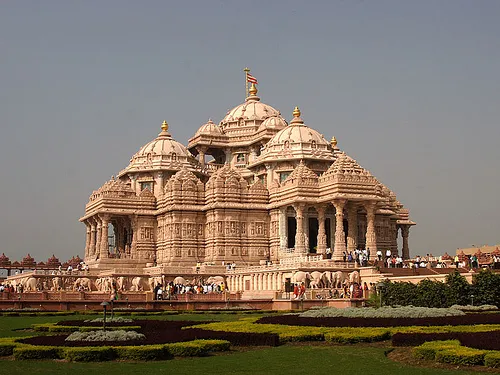
Quick Facts
- Location: East Delhi, banks of the Yamuna River, near Nizamuddin Bridge
- Address: Noida Mor, Pandav Nagar, New Delhi – 110092
- Deity: Bhagwan Swaminarayan
- Built: Inaugurated November 6, 2005
- Built by: BAPS Swaminarayan Sanstha (volunteer artisans and devotees)
- Open: Tuesday to Sunday, 9:30 AM – 6:30 PM
- Closed: Every Monday (plan accordingly)
- Last entry: 6:00 PM
- Entry cost: Free for temple complex and gardens; exhibitions ₹250–300 extra
- Water show ticket: ~₹80–100 (separate ticket)
- Time needed: 3–5 hours minimum
- Nearest metro: Akshardham Station, Blue Line (Exit Gate 1)
- Best months: October to March (cooler weather)
- World record: Guinness World Record – largest comprehensive Hindu temple (awarded December 2007)
About the Temple and Bhagwan Swaminarayan
Bhagwan Swaminarayan (1781–1830) was a Hindu saint born in Chhapaiya, Uttar Pradesh. At age 11 he left home and spent seven years as an ascetic called Neelkanth, walking over 12,000 kilometres across India on foot — from the Himalayas in the north to Rameshwaram in the south. He settled in Gujarat, where he built a following and taught a path centred on devotion, non-violence, and personal conduct.
He founded the Swaminarayan Sampraday in 1801 and constructed six temples during his lifetime in Gujarat. His teachings drew followers from all castes and communities, and he actively reformed social practices including the treatment of women and people from lower castes.
The BAPS (Bochasanwasi Akshar Purushottam Swaminarayan Sanstha) is one of the main branches of this tradition. They built the Delhi complex using over 11,000 artisans and volunteers from across India. No paid labour was brought in from outside — the construction was entirely through volunteerism. It took five years, completed in 2005.
The Architecture
Main Temple
The central temple building is 141 feet tall, 316 feet wide, and 356 feet long. It was built entirely from pink Rajasthani sandstone and Italian white marble — no steel or concrete was used anywhere. Pieces are held together using ancient stone interlocking techniques. The structure has five domes, nine shikharas (spires), 234 carved pillars, and over 20,000 sculptures throughout the exterior and interior.
Gajendra Pitha (The Elephant Plinth)
The temple stands on a plinth surrounded by 148 life-size stone elephants, each carved from a single block of stone and weighing approximately 20 tonnes. They represent strength and wisdom and are modelled on different elephant postures. Walking around the base to look at each one takes about 10–15 minutes.
Yagnapurush Kund (The Step-Well)
One of the largest step-wells in the world. It has 108 smaller shrines along its edges and 2,870 steps arranged in a star pattern descending to a central fountain. The design is modelled on traditional Indian vav (step-well) architecture. This is the venue for the nightly water show.
Narayan Sarovar
The main temple is surrounded by this moat-like pond. Water was collected from 151 sacred rivers, lakes, and ponds across India during a dedicated procession before the temple opened. Devotees consider the sarovar ritually significant.
Bharat Upavan (Garden of India)
A landscaped garden featuring 96 bronze statues of people from Indian history — scientists, reformers, poets, warriors, and philosophers. The garden is freely accessible and a good place to walk after the temple visit.
The Three Exhibitions (Paid)
These are sold as a combined ticket (₹250–300). Each exhibition is in a separate hall and has its own entry point. Allow 75–90 minutes for all three.
1. Sahajanand Darshan (~15 minutes)
An animatronic show featuring life-size robotic figures depicting scenes from Swaminarayan's life — his childhood, his years of wandering as Neelkanth, and his time as a teacher in Gujarat. The figures have realistic facial movement and synchronised audio in multiple languages. The technology is comparable to high-end theme park animatronics.
2. Neelkanth Darshan (~40 minutes)
A large-format film about Swaminarayan's seven-year pilgrimage across India as a young ascetic from 1792 to 1799. It was shot on location across India and covers actual geography, pilgrimage routes, and the variety of Hindu traditions he encountered. This is the longest of the three and the most cinematically produced. Visitors without a religious interest in Swaminarayan still find the travelogue elements interesting.
3. Sanskruti Vihar – Boat Ride (~13 minutes)
A slow boat ride through a series of dioramas depicting 10,000 years of Indian cultural history. Scenes include the Vedic period, ancient universities like Nalanda and Takshashila, contributions to mathematics (including the concept of zero and Aryabhata's work), Ayurveda, and classical arts. Calm, family-friendly, and accessible to children.
Are the exhibitions worth paying for?
For most visitors, yes. The boat ride and film alone justify the cost. If your visit is under 2 hours total, skip the exhibitions and use the time for the main temple and garden.
Sahaj Anand Water Show (Evening)
The nightly water show runs at the Yagnapurush Kund (the step-well) and lasts approximately 24 minutes. It uses fountains, laser projections, LED lighting, and fire effects to narrate a story about the soul's journey — drawn from Vedantic philosophy. The production quality is high by Indian standards.
Approximate timings:
- October–March: ~7:30 PM
- April–September: ~7:45 PM
Ticket: Separate from exhibitions — approximately ₹80–100 per person.
Important: The water show runs after the complex's official closing time of 6:30 PM. If you plan to see it, arrange to stay for the evening. Check the official Akshardham website for exact timings on your visit date, as they adjust seasonally.
Aarti and Prayer Timings
Daily aarti (prayer rituals) are conducted in the main temple. Visitors can observe from designated viewing areas — participation is not required.
- Daytime Aarti: Conducted at scheduled intervals during temple hours, typically around 12:00 PM
- Evening Aarti: Before the temple closes, around 5:30–6:00 PM
- Prasadam: Blessed food distributed after the evening aarti
Timings shift on major festival days. Temple staff at the entrance can confirm exact times for your visit.
Photography — Where Allowed
This causes the most confusion among visitors:
| Area | Photography |
|---|---|
| Bharat Upavan garden | ✅ Allowed |
| Temple exterior from the outside | ✅ Allowed |
| Inside the main temple | ❌ Not allowed |
| Exhibition halls | ❌ Not allowed |
| Water show area | Check on arrival |
Mobile phones and cameras must be deposited at the cloakroom before entering the main temple. The cloakroom is near the temple entrance and charges ₹25–50. It's mandatory, not optional.
Visiting with Children
Akshardham works well for children aged 5 and above:
- The animatronic show and boat ride do not require prior knowledge of Swaminarayan tradition to be engaging
- The 148 stone elephants around the base are a reliable crowd-pleaser for younger visitors
- The Bharat Upavan garden provides open space to move around
- The evening water show with fountains and lights appeals to most age groups
Allow extra time at security and cloakrooms if you have strollers or multiple bags. Wheelchair ramps and wheelchairs are available throughout.
Akshardham Delhi vs Akshardham Gandhinagar
There are two major Akshardham complexes — Delhi (2005) and Gandhinagar, Gujarat (1992). They share the same tradition but are different in scale and atmosphere.
| Feature | Delhi (2005) | Gandhinagar (1992) |
|---|---|---|
| Size | 100 acres, larger overall | Smaller footprint |
| Main temple height | 141 feet | Lower |
| Guinness Record | Yes — largest comprehensive Hindu temple | No |
| Exhibitions | 3 exhibitions + water show | Different exhibitions + water show |
| Crowds | Higher (Delhi draws more tourists) | Quieter, more manageable |
| Atmosphere | Tourist-heavy, high footfall | More devotee-focused, calmer |
| Who should go | First-time visitors, families | BAPS devotees, anyone wanting a quieter experience |
If you are visiting India for the first time and can only see one, Delhi makes more sense for the scale and the range of exhibitions. If you are in Gujarat and already plan to visit Ahmedabad or Gandhinagar, the Gujarat complex is worth visiting separately.
When It's Most Crowded
Month-by-Month Crowd Guide
| Month | Crowd Level | Main Reason |
|---|---|---|
| January | Moderate | Cool weather, general tourism; Republic Day (Jan 26) brings extra visitors |
| February | Moderate | Pleasant weather, fewer peak events |
| March | Busy | Holi (date varies by year); spring tourist traffic picking up |
| April | Very Busy | Swaminarayan Jayanti — founder's birthday (Chaitra Shukla 9); BAPS followers arrive in organised groups from across India and abroad; single busiest day of the year |
| May–June | Busy but hot | Summer school holidays; families travelling Delhi before the heat becomes extreme |
| July–August | Low–Moderate | Monsoon season; schools in session; fewer tourists |
| September | Moderate–Busy | Weather improving; Navratri approaching |
| October | Very Busy | Navratri and Dussehra; major Hindu festival season begins |
| November | Very Busy | Diwali (date varies); complex lit with thousands of lights; peak pilgrimage crowd |
| December | Busy | Christmas break and winter tourism; pleasant weather |
Specific High-Crowd Dates
Swaminarayan Jayanti (April) — This is the single most crowded day at Akshardham Delhi. BAPS groups travel from Gujarat, Maharashtra, UK, USA, and East Africa specifically for this day. Expect queues of 2–3 hours. If you are not a devotee visiting for the occasion, pick a different date.
Diwali week (October–November) — The complex is decorated with oil lamps and lights. It looks extraordinary but draws enormous crowds. Lines during Diwali evening can run 2–3 hours.
Long weekends combining Republic Day or Independence Day — Delhi fills with domestic tourists, and Akshardham is a standard itinerary stop.
Summer Sundays (April–June) — Families on weekend outings combined with tourist groups make Sunday the worst day of the week. Avoid 11 AM – 3 PM specifically.
Best Days and Times to Visit with Shortest Queues
- Best days: Tuesday to Thursday
- Best time: Arrive at 9:30 AM when the complex opens
- Best months: February, July–August (heat trade-off), early September
Getting to Akshardham
By Metro (Recommended)
Akshardham Metro Station — Blue Line (Line 3)
Get off at Akshardham Station and use Exit Gate 1. The temple entrance is a 5-minute walk.
The Blue Line connects: Dwarka Sector 21 ↔ Janakpuri ↔ Rajouri Garden ↔ Rajiv Chowk (Connaught Place) ↔ Pragati Maidan ↔ Akshardham ↔ Mayur Vihar ↔ Noida City Centre
Metro fare: ₹30–60 depending on your starting point. Journey times from central Delhi: ~25–35 minutes.
By Train — Getting to Delhi
Delhi has five major railway stations. Here's which station to aim for and how to reach the temple from each:
New Delhi Railway Station (NDLS) — 12 km from temple
- Take Blue Line metro from New Delhi Metro Station → Akshardham (~25 min, ~₹40)
- Receives: Most Rajdhani Express trains (Mumbai, Kolkata, Ahmedabad, Jaipur), most Shatabdi trains, and high-frequency intercity trains
Hazrat Nizamuddin (NZM) — 10 km from temple
- Take Blue Line from Hazrat Nizamuddin → Akshardham (~30 min)
- Receives: Mumbai Rajdhani (12951/12952), Chennai Rajdhani (12433/12434), Bangalore Rajdhani (22691/22692), Bhopal Shatabdi, Duronto Express trains
Anand Vihar Terminal (ANVT) — 6 km from temple (closest station)
- Take Blue Line from Anand Vihar ISBT Metro Station → Akshardham (~15 min)
- Receives: Trains from Uttar Pradesh (Lucknow, Varanasi, Gorakhpur), Bihar (Patna, Muzaffarpur), and northeast India
Old Delhi Railway Station (DLI) — 15 km from temple
- Yellow Line metro from Chandni Chowk → transfer to Blue Line at Rajiv Chowk → Akshardham (~40 min)
- Receives: Trains from Rajasthan (Jaipur, Jodhpur, Bikaner), Amritsar, Jammu, and Pathankot; many slower express trains
Sarai Rohilla (DEE) — 18 km from temple
- Metro to Purani Delhi Road → Yellow Line → Rajiv Chowk → Blue Line → Akshardham (~50 min)
- Receives: Trains from Rajasthan and some Gujarat routes
Train Routes from Major Cities
| From | Recommended Train | Duration | Arrives at |
|---|---|---|---|
| Mumbai | 12951 Mumbai Rajdhani | ~16 hrs | Hazrat Nizamuddin |
| Ahmedabad | 12957 Rajdhani / 12009 Shatabdi | 8–9 hrs | H. Nizamuddin / New Delhi |
| Kolkata | 12301 Howrah Rajdhani | ~17 hrs | New Delhi |
| Chennai | 12434 Chennai Rajdhani | ~28 hrs | Hazrat Nizamuddin |
| Bangalore | 22691 Bangalore Rajdhani | ~34 hrs | Hazrat Nizamuddin |
| Jaipur | 12015 Ajmer Shatabdi | ~4.5 hrs | New Delhi |
| Varanasi | 12560 Shiv Ganga Express | ~11 hrs | New Delhi |
| Lucknow | 12003 Lucknow Shatabdi | ~6 hrs | New Delhi |
| Amritsar | 12013 Amritsar Shatabdi | ~5.5 hrs | New Delhi |
| Hyderabad | 12723 Telangana Express | ~25 hrs | New Delhi |
| Pune | 12263 Pune Duronto | ~18 hrs | Hazrat Nizamuddin |
| Bhopal | 12001 Bhopal Shatabdi | ~5 hrs | New Delhi |
Book tickets at irctc.co.in (official Indian Railways booking site). Rajdhani and Shatabdi trains fill up weeks ahead during October–March. If booking close to travel, check for Tatkal quota (opens 1 day before) at a higher fare.
From Delhi Airport (IGI)
By metro (cheapest and usually fastest):
- Airport Express Line from Terminal 1D / 2 / 3 → New Delhi Railway Station (~20 min)
- Blue Line from New Delhi → Akshardham (~25 min)
Total time: ~50 minutes. Cost: ~₹100–120.
By cab: ₹400–700, roughly 45–60 minutes depending on traffic. Pre-book via Uber or Ola from inside the airport.
By Car
The complex is on NH-9 (formerly NH-24) near Nizamuddin Bridge, East Delhi. It's clearly visible and signposted from the highway. Paid parking is available inside the complex. Avoid arriving between 5–8 PM on weekdays (heavy commuter traffic on NH-9).
Visiting Information
Hours
Open: Tuesday to Sunday
Timings: 9:30 AM – 6:30 PM (last entry 6:00 PM)
Closed: Every Monday — no exceptions
Costs
| What | Cost |
|---|---|
| Main temple complex and gardens | Free |
| All three exhibitions (combined ticket) | ₹250–300 |
| Sahaj Anand Water Show | ~₹80–100 |
| Cloakroom (phone, camera, bag deposit) | ₹25–50 |
| Vegetarian meals at food court | ₹100–300 per person |
Dress Code (Strictly Enforced)
- Shoulders and knees must be covered
- No shorts, sleeveless tops, or revealing clothes
- Clean, modest clothing
- Guards check at the entrance — visitors who don't meet the standard are turned away
What Is Not Allowed Inside the Main Temple
- Mobile phones, cameras, and any electronic devices
- Bags (except very small purses)
- Food, drinks, tobacco, and alcohol
All of the above must be deposited at the cloakroom near the temple entrance before entry.
Facilities Inside the Complex
- Cloakroom for phones, bags, cameras (near temple entrance)
- Vegetarian food courts (no non-veg food is sold or allowed on the premises)
- Clean and well-maintained toilets throughout
- Drinking water stations
- Wheelchair access ramps and wheelchairs available on request
- Basic first aid station
Nearby Attractions
If you're spending a full day in Delhi, these are within reasonable distance:
- Lotus Temple (~10 km) — Bahá'í house of worship in a dramatic flower shape. Free entry. Very peaceful. Allow 45–60 minutes.
- Humayun's Tomb (~10 km) — UNESCO World Heritage Site. The architectural precursor to the Taj Mahal. Worthwhile for anyone interested in Mughal history.
- Purana Qila (Old Fort) (~12 km) — One of Delhi's oldest surviving fortifications. Good for history.
- ISKCON Temple (~15 km, East of Kailash) — A major Krishna temple if you want another significant religious site in the same day.
- Connaught Place (~12 km) — Central Delhi's main hub for food and shopping.
A practical day plan: Arrive at Akshardham at 9:30 AM, finish by 1:30–2 PM, visit Lotus Temple in the afternoon, then Humayun's Tomb before it closes at sunset.
Frequently Asked Questions
Can non-Hindus visit Akshardham?
Yes. The temple is open to visitors of all faiths. There is no requirement to participate in any ritual or prayer.
Is Akshardham free to enter?
The main temple complex and gardens are free. The three exhibition halls cost ₹250–300 (combined ticket). The water show is an additional ₹80–100.
Is Akshardham closed on any day?
It is closed every Monday. This catches many visitors off guard — check before you go.
How long does Akshardham take?
Just the main temple and gardens: 1.5–2 hours. Temple plus all three exhibitions: 3–4 hours. Full visit including the water show: 4–6 hours.
Is photography allowed inside Akshardham?
In the outdoor gardens and around the temple exterior: yes. Inside the main temple and exhibition halls: no. Phones must be left at the cloakroom before entering the temple.
Can I visit Akshardham with young children?
Yes. The boat ride, animatronic show, and elephant base are well-suited for children aged 5 and above. The garden provides open space. Wheelchair ramps accommodate strollers.
What is the difference between Akshardham Delhi and Akshardham Gandhinagar?
The Delhi complex (2005) is larger, holds the Guinness record, and draws more tourists. The Gandhinagar complex (1992) in Gujarat is older, smaller, and quieter. If you can only visit one, Delhi makes sense. They are separate visits, not duplicates.
Which is the most crowded day to visit?
Swaminarayan Jayanti in April is the single busiest day. Diwali week is the second most crowded. Any Sunday between October and March also has long queues.
What is the best time to visit to avoid crowds?
Tuesday to Thursday mornings, arriving when the complex opens at 9:30 AM. The quietest months are July and August (monsoon season), though the heat and humidity are a trade-off.
Is the Sahaj Anand Water Show worth watching?
Most visitors say yes. It runs for 24 minutes and uses fountains, lasers, fire, and narration. If you're already at the complex in the evening, plan your visit around it. Arrive by 5 PM at the latest to see the exhibitions first, then wait for the show.
Can I bring outside food?
No. Outside food and drinks are not allowed. Vegetarian meals are available at the food courts inside the complex.
Is there parking at Akshardham?
Yes, paid parking is available at the complex. Access from NH-9. Avoid arriving during evening rush hours (5–8 PM) when traffic on NH-9 is heavy.
Quick Reference
- Closed: Mondays
- Free entry: Yes (exhibitions and water show cost extra)
- Nearest metro: Akshardham Station, Blue Line, Exit Gate 1
- No phones inside the temple: Mandatory cloakroom deposit
- No steel or concrete in the main building: Stone interlocking only
- Guinness record: World's largest comprehensive Hindu temple (December 2007)
- Swaminarayan Jayanti: Busiest day of the year — avoid if you want a calm visit
- Water show: Nightly, ~7:30–7:45 PM, approximately 24 minutes