
Maha Ashtami and Maha Navami 2026: Dates, Timings, and Key Rituals
Published by the Vedic Tithi Team — October 2026
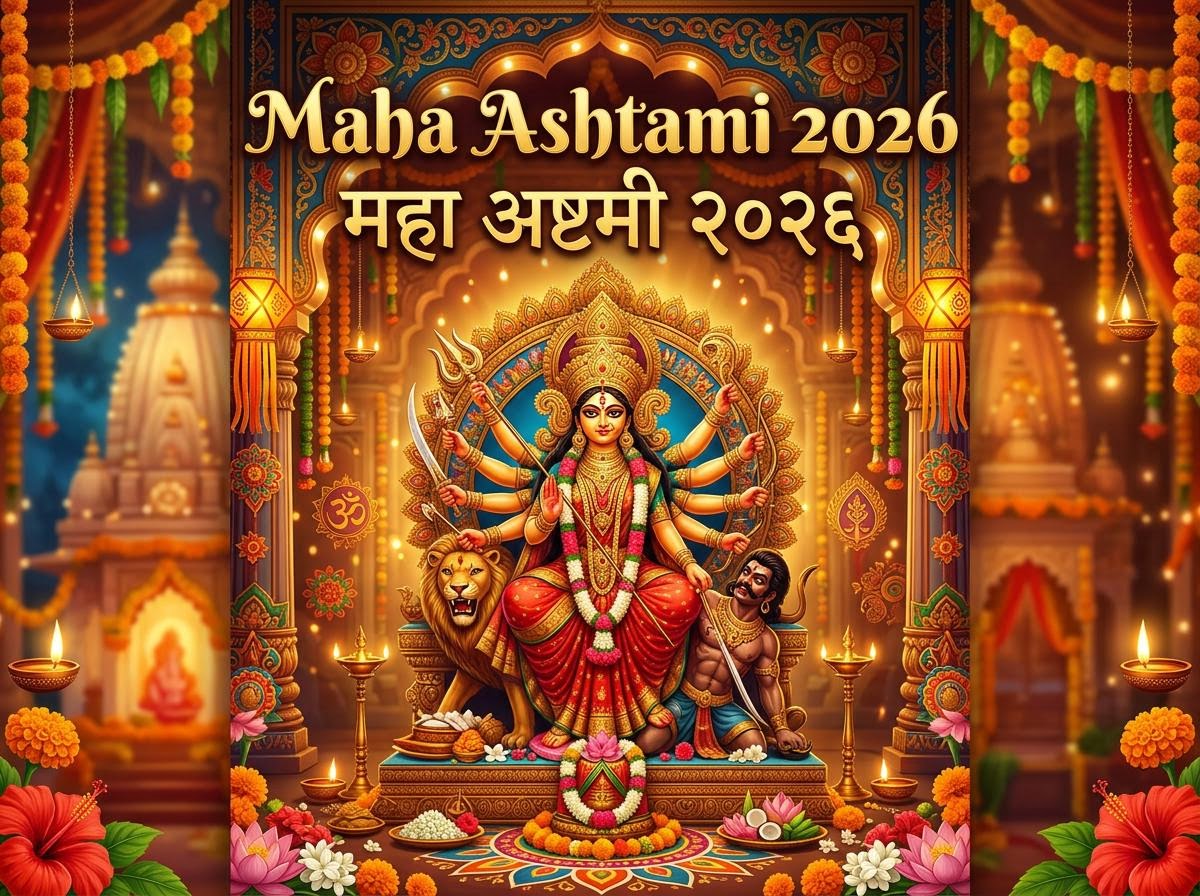
Maha Ashtami 2026 falls on Sunday, October 18 and Maha Navami on Monday, October 19 — the two most intensely observed days of Durga Puja. This article covers the tithi windows, Sandhi Puja timing, Kumari Puja, Navami Homa, Pushpanjali, and how temples across North America and India observe both days.
What are Maha Ashtami and Maha Navami? Maha Ashtami is the 8th day and Maha Navami the 9th day of Sharad Navratri. Together they form the climax of Durga Puja. The Sandhi Puja — a 48-minute ritual at the exact tithi junction — is the single most intense moment of the entire festival. In 2026, Maha Ashtami is October 18 and Maha Navami is October 19.
Contents
- When Is Maha Ashtami 2026?
- When Is Maha Navami 2026?
- What Is Sandhi Puja and When Does It Happen?
- What Happens During Maha Ashtami?
- What Happens During Maha Navami?
- Durga Puja 2026 Events Across North America
- Major Pandals in Kolkata
- Frequently Asked Questions
- References
When Is Maha Ashtami 2026?
Maha Ashtami 2026 is on Sunday, October 18. The Ashtami tithi — the 8th lunar day of Ashwin Shukla Paksha — governs this date. Based on the Sharad Navratri starting October 12, 2026, and Vijayadashami falling on October 20, Maha Ashtami lands on October 18. Exact tithi start and end times vary by your location — verify on DrikPanchang for your city.
The Ashtami tithi will begin on the evening of October 17 (Saturday) and run through most of October 18. Puja is performed during the morning hours, continuing through the afternoon until Sandhi Puja marks the end of Ashtami and the beginning of Navami.
See the full panchang on the Hindu calendar for October 2026. Confirm the tithi window on the daily panchang for October 18 before planning your rituals.
When Is Maha Navami 2026?
Maha Navami 2026 is on Monday, October 19. Navami tithi — the 9th lunar day — follows directly from Ashtami. Vijayadashami, when Devi's idol is immersed, falls the next day on October 20.
Navami is the last complete day of Durga Puja. The morning puja continues from Ashtami, and the Navami Homa (fire ritual) is the centrepiece of the day. By the evening, families and community groups begin preparations for the Dashami sendoff.
Confirm the Navami tithi window on the daily panchang for October 19.
What Is Sandhi Puja and When Does It Happen?
Sandhi Puja is a 48-minute ritual performed at the exact junction of the Ashtami and Navami tithis. It is the most precisely timed and most intensely observed moment in all of Durga Puja.
Sandhi means junction or meeting point. The ritual spans the last 24 minutes (2 ghatikas) of Ashtami and the first 24 minutes of Navami — a narrow window that shifts each year based on when Navami tithi begins locally.
In 2026, Sandhi Puja will fall in the evening of October 18, transitioning into October 19. The exact minute depends on when Navami tithi begins at your location. Check DrikPanchang for the precise window in your city before making plans.
Why Is Sandhi Puja Significant?
The Devi Mahatmyam (part of the Markandeya Purana) describes how the goddess Durga killed the demons Chanda and Munda at the junction of these two tithis. She took the form of Chamunda — her most fierce manifestation — at this exact moment. Sandhi Puja commemorates that event.
How Is Sandhi Puja Performed?
- 108 lamps (diyas) are lit in front of the Devi idol — all 108 must be burning at the same time.
- The priest performs Chamunda puja with offerings specific to this form of the goddess, distinct from the regular Durga puja.
- A symbolic bali (sacrifice) takes place. In most communities today this is a pumpkin (kumro), banana stalk, or sugarcane — not a live animal.
- Specific Chandi Patha mantras from the Devi Mahatmyam are recited continuously through all 48 minutes.
- No one enters or leaves the puja space during Sandhi Puja. The ritual runs uninterrupted from start to finish.
The crowd at even the noisiest pandal typically goes quiet without being told when Sandhi Puja begins. Plan to arrive at least 30–45 minutes early to get a clear view.
What Happens During Maha Ashtami?
Maha Ashtami is a full day of puja with three major components: Pushpanjali, Kumari Puja, and Sandhi Puja. Here is how the day unfolds.
Morning: Ashtami Puja
The day begins with Mahasnan — ritual bathing of the Devi idol — followed by Shodashopachara puja (16-step worship). Each of the 16 steps, from offering a seat (asana) to waving lamps (deepa), is performed with mantras from the Devi Mahatmyam.
What Is Pushpanjali on Ashtami?
Pushpanjali means offering flowers with mantras. On Maha Ashtami, Pushpanjali is performed three times — once in the morning, once at midday, and once just before Sandhi Puja.
How to Perform Pushpanjali
- Stand facing the Devi idol with both palms cupped and filled with flowers — typically bela (wood apple), aparajita (clitoria), or shiuli (night jasmine).
- The priest recites mantras from the Devi Mahatmyam — primarily Chapter 11 (Narayani Stuti).
- Repeat each line after the priest.
- At the end of the recitation, release the flowers together toward the Devi.
- Repeat the process two more times.
Most temples begin morning Pushpanjali at 7:00–8:00 AM. Arrive 30 minutes early — the pandal fills fast on Ashtami morning.
What Is Kumari Puja?
Kumari Puja is the worship of a young girl — aged 5 to 9 — as a living form of the goddess. The girl is bathed, dressed in red, adorned with ornaments, and seated in front of the Devi idol. The priest performs the same puja to the girl as to the idol.
The Devi Bhagavatam names nine kumari forms based on the girl's age:
| Age | Name | Form of Devi |
|---|---|---|
| 1 year | Sandhya | Durga |
| 2 years | Saraswati | Saraswati |
| 3 years | Tridhamurti | Lakshmi |
| 4 years | Kalyani | Kali |
| 5 years | Rohini | Saraswati |
| 6 years | Kali | Kali |
| 7 years | Chandika | Chandika |
| 8 years | Shambhavi | Durga |
| 9 years | Durga | Ambika |
Larger celebrations worship all 9 simultaneously, one girl for each form. Ramakrishna Mission centers — including Belur Math in Howrah — follow this tradition rigorously. Their Kumari Puja on Maha Ashtami morning is one of the most attended events in Bengal, drawing tens of thousands of people.
What Happens During Maha Navami?
Maha Navami begins with Durga puja continuing from Ashtami, then moves into the Navami Homa — the centrepiece ritual of the day — followed by Maha Aarti and community bhog.
What Is the Navami Homa?
Navami Homa is a fire ritual (havan) in which 108 offerings (ahutis) of ghee, sesame, rice, and medicinal herbs are made into a sacred fire with Chandi mantras.
How Navami Homa Is Performed
- The priest consecrates the fire with Agnisthapana mantras and the havan kund (fire pit) is lit.
- 108 ahutis are offered into the fire — each accompanied by the mantra "Om Aim Hreem Kleem Chamundaye Vichche Swaha."
- Passages from the Devi Mahatmyam are recited throughout the homa.
- At the conclusion, purnahuti — the final complete offering — is made with a large ladle of ghee, alongside red cloth, coconut, and flowers.
- Vibhuti (sacred ash) from the havan is distributed to all devotees present.
The homa typically runs 2–4 hours depending on the scale of the ceremony. Large pandals in Kolkata begin as early as 6:00 AM. Diaspora temples often schedule mid-morning to allow working families to attend.
Maha Aarti
Following the homa, Maha Aarti is performed — the full lamp-waving ceremony with conch shells, bells, and dhak (Bengali drums). Everyone present participates. The aarti plate is passed through the crowd so each person can wave it before the Devi.
Navami Bhog
Navami bhog (prasad meal) is a major community occasion. Traditional Durga Puja bhog includes:
- Khichdi — rice and lentils cooked with seasonal vegetables and spices
- Labra — a mixed vegetable stew cooked without onion or garlic
- Paayesh — rice pudding made with milk and jaggery or sugar
- Chutney — raw mango or tomato, sweet and tangy
- Boondi — fried gram flour balls, sweet
Large pandals in Kolkata serve bhog to thousands across both Ashtami and Navami. In diaspora communities, bhog is cooked by volunteers and served in the evening after puja.
Durga Puja 2026 Events Across North America
Vancouver / Surrey, British Columbia
The Durga Puja Association of BC (dpbc.ca) has organized Sharad Puja in the Vancouver area for over two decades. Their four-day celebration covers Saptami through Dashami with Pushpanjali, Kumari Puja, Sandhi Puja, and community bhog. Contact them directly for confirmed 2026 Ashtami and Navami timings.
The Bengali Cultural Association of BC in Surrey runs a separate celebration. Contact them directly for confirmed 2026 timings.
Toronto, Ontario
Bengali Cultural Society of Toronto (BCST) organizes one of Ontario's largest Durga Puja celebrations. Their Maha Ashtami program includes morning Pushpanjali, Kumari Puja, and Sandhi Puja followed by cultural performances. Contact BCST directly for confirmed 2026 program details.
Hindu Heritage Centre in Mississauga also hosts Navratri and Durga Puja events across the four main days. Contact the centre directly for 2026 timings.
New York
The Durga Puja Society of New York (dpsny.org) is among the oldest Bengali cultural organizations in the United States. Their annual puja draws thousands over the four main days. Sandhi Puja at DPSNY is a full ceremonial event with 108 lamps and symbolic bali. Contact them directly for 2026 schedule.
Bharatiya Temple in Chantilly, Virginia, also hosts a significant Durga Puja event accessible to the greater New York–DC corridor. Contact the temple directly for 2026 Ashtami and Navami programs.
Dallas, Texas
The Dallas Bengali community organizes Dallas Durga Puja each year with all four main days including puja, Kumari Puja, cultural programs, and community bhog. Contact the organizing committee directly for confirmed 2026 Ashtami and Navami event details.
San Francisco Bay Area
Bay Area Durga Puja runs celebrations across multiple venues in the Bay Area. Sandhi Puja and Kumari Puja are standard parts of their Maha Ashtami program. Contact the Bay Area Durga Puja committee directly for 2026 venue locations and timings.
Major Pandals in Kolkata
Kolkata runs around the clock on Maha Ashtami and Maha Navami. Thousands of pandals operate across the city, and the metro runs extended hours during the festival period.
Ramakrishna Mission Belur Math, Howrah
Belur Math's Kumari Puja on Maha Ashtami is the most attended in Bengal. The Math worships 9 girls simultaneously as the nine Kumari forms. Crowds begin forming from before dawn. The puja itself runs from approximately 7:30–10:00 AM. Take the ferry from Dakshineswar or bus to Belur Math directly. Contact the Math directly for confirmed 2026 timings at belurmath.org.
Kumartuli Park Sarbojanin, North Kolkata
One of North Kolkata's largest and best-known celebrations. Located adjacent to the Kumartuli artisan district, where most of the city's Durga idols are crafted. The pandal is accessible from Shyambazar metro station. Sandhi Puja here draws very large crowds — plan to arrive 1 hour early.
Bagbazar Sarbojanin, North Kolkata
Founded in 1919, one of Kolkata's oldest community pujas. Maha Ashtami Pushpanjali begins at 6:00 AM, with queues forming from 4:00 AM. The Sandhi Puja is performed with the full 108-lamp ceremony. Accessible from Shyambazar.
College Square Sarbojanin, Central Kolkata
A landmark puja in central Kolkata, known for large-scale thematic pandals. Navami Homa here begins early morning with full Chandi Patha recitation. Located near College Street, easily accessible from central Kolkata.
Ekdalia Evergreen Club, South Kolkata
A consistently top-rated puja in South Kolkata. Accessible via Gariahat. Known for thoughtfully designed pandals with full ceremonial puja across all four days. Contact the club directly for confirmed 2026 Ashtami and Navami timings.
For Kolkata pandal routes on Ashtami and Navami nights: the Kolkata Metro runs until 1:00 AM during Durga Puja. Crowds peak between 9:00 PM and 2:00 AM. Early morning (5:00–8:00 AM) is the best time for unhurried darshan and to witness Pushpanjali.
Frequently Asked Questions
When is Maha Ashtami in 2026?
Maha Ashtami 2026 is on Sunday, October 18. The Ashtami tithi of Ashwin Shukla Paksha governs this date. Exact tithi start and end times vary by location — verify on DrikPanchang for your city.
When is Maha Navami in 2026?
Maha Navami 2026 is on Monday, October 19. It follows immediately from Maha Ashtami and precedes Vijayadashami (October 20). The Navami Homa is the main ritual of the day, typically performed in the morning.
What time is Sandhi Puja in 2026?
Sandhi Puja falls at the junction of Ashtami and Navami tithis — the last 24 minutes of Ashtami and the first 24 minutes of Navami, a 48-minute window. In 2026, this falls in the evening of October 18. The exact time depends on your location. Verify on DrikPanchang before making plans.
What is Kumari Puja and who performs it?
Kumari Puja is the worship of a girl aged 5–9 as a living form of Devi. The Devi Bhagavatam describes nine kumari forms based on age. Ramakrishna Mission Belur Math in Howrah performs the most well-known Kumari Puja in India. Diaspora temples in Toronto, New York, and Vancouver also observe Kumari Puja on Maha Ashtami morning.
How many lamps are lit during Sandhi Puja?
108 lamps are lit simultaneously during Sandhi Puja. All 108 must be burning at the same time. The number 108 corresponds to the 108 Shakti Peethas — sites sacred to the goddess — described in the Puranas.
What is the Navami Homa and how long does it take?
Navami Homa is a fire ritual with 108 ahutis of ghee, sesame, and rice made into a sacred fire with Chandi mantras. It typically runs 2–4 hours. Large Kolkata pandals begin as early as 6:00 AM on Navami morning. The homa ends with purnahuti — a final large offering of ghee, coconut, and red cloth.
Why is the Ashtami-Navami junction so important?
The Devi Mahatmyam (Markandeya Purana) says the goddess killed the demons Chanda and Munda at the junction of Ashtami and Navami. She took the form of Chamunda — her most fierce form — at this exact moment. Sandhi Puja recreates and honors that event.
What food is served as bhog on Navami?
Traditional Navami bhog includes khichdi (rice and lentils with vegetables), labra (mixed vegetables, no onion or garlic), paayesh (rice pudding), chutney, and boondi. Large Kolkata pandals serve this to thousands. Diaspora communities typically serve bhog after the evening puja.
Maha Ashtami: October 18, 2026. Maha Navami: October 19, 2026. Sandhi Puja falls at the Ashtami–Navami tithi junction on the evening of October 18 — confirm the exact time on DrikPanchang for your location. Kumari Puja is performed on Ashtami morning; Navami Homa runs through the morning of October 19. The Hindu calendar for October 2026 has the full panchang view for the festival period.
Jai Maa Durga!
References
- DrikPanchang — Durga Puja 2026 Dates and Tithi Timings — source for all panchang and tithi timings
- Devi Mahatmyam (Markandeya Purana) — scriptural basis for Sandhi Puja, Chamunda form, and the narrative of Chanda-Munda
- Devi Bhagavatam — source for the nine Kumari forms and their corresponding Devi aspects
- Ramakrishna Mission Belur Math — Kumari Puja tradition and annual observance details
- Durga Puja Society of New York — North America community event reference
- Durga Puja Association of BC — Vancouver/Surrey community event reference