
Mahakaleshwar Temple Ujjain
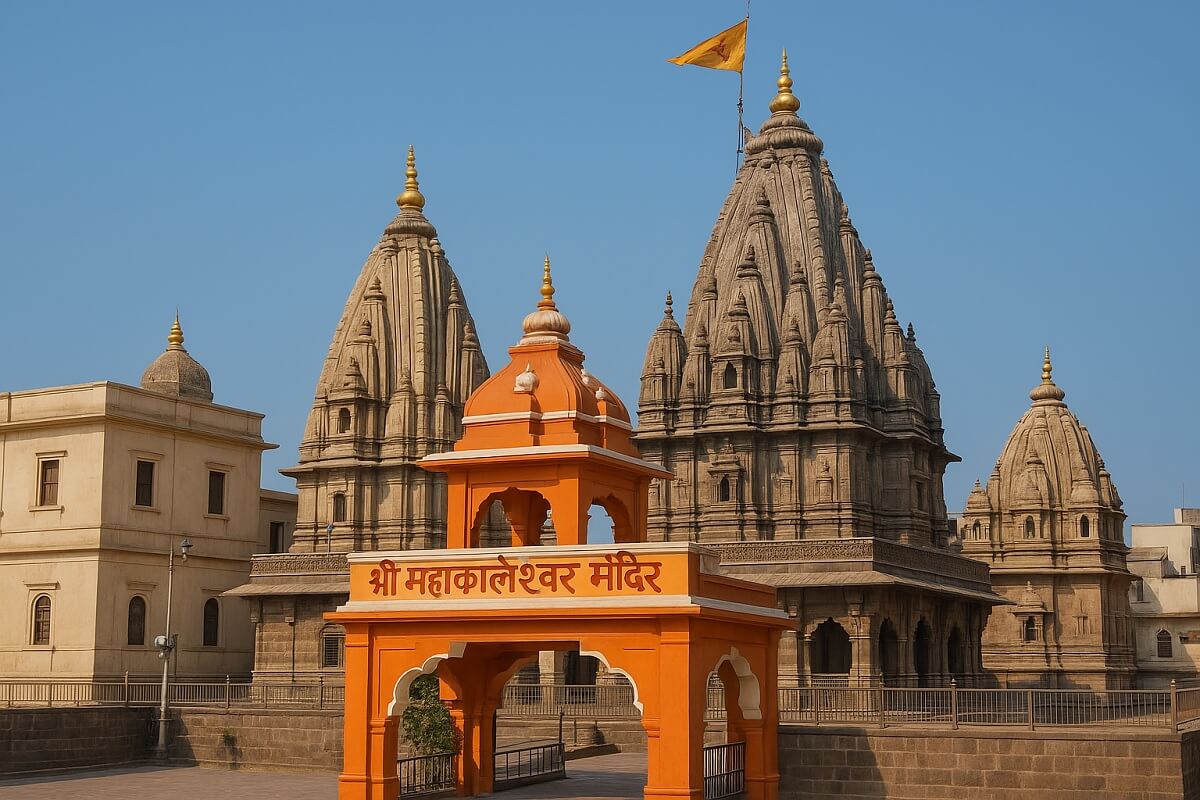
Mahakaleshwar Temple is a major Hindu temple dedicated to Lord Shiva and is one of the twelve Jyotirlingas in India. Located in the ancient city of Ujjain in Madhya Pradesh, it sits on the banks of the Shipra River. The temple is a significant pilgrimage site for devotees of Shiva and is known for its unique rituals and its status as the only south-facing Jyotirlinga.
The temple complex is large and includes the newly developed Mahakal Lok corridor. Visitors should plan for several hours to complete their visit, especially if they intend to participate in specific rituals like the Bhasma Aarti. The site is accessible by road, rail, and air, with Ujjain being a well-connected city in central India.
Quick Facts
| Field | Details |
|---|---|
| Deity | Lord Shiva (Mahakal) |
| Location | Ujjain, Madhya Pradesh |
| State | Madhya Pradesh |
| Temple Type | Jyotirlinga (3rd of 12) |
| Nearest Metro/Station | Ujjain Junction (2 km) |
| Nearest Airport | Devi Ahilya Bai Holkar Airport, Indore (55 km) |
| Entry Fee | Free for general darshan; Paid tickets for fast entry (₹250) |
| Timings | 4:00 AM to 11:00 PM |
| Best Months | October to March |
| Avoid | Summer months (April-June) and peak festival days if you dislike crowds |
History and Background
The Mahakaleshwar Temple has a long history that spans several millennia. It is mentioned in several ancient Indian texts, including the Puranas and the works of the poet Kalidasa in the 4th century. The city of Ujjain, formerly known as Avantika, was a center of learning, trade, and religion in ancient India. The temple has always been the focal point of this city.
The original structure of the temple is believed to have been established in the prehistoric period. However, the recorded history of the temple's construction and renovation begins with the Paramara dynasty, who ruled the region between the 9th and 12th centuries. During this time, the temple was a center for the Kapalika and Pashupata sects of Shaivism.
In 1234-1235 AD, the temple was attacked and destroyed by Shams-ud-din Iltutmish, the Sultan of Delhi, during his raid on Ujjain. The Jyotirlinga was reportedly removed and thrown into a nearby pond called the Kotiteertha Kunda. For nearly five hundred years after this event, the site remained without a formal large-scale temple structure, though worship continued in smaller capacities.
The current structure was built in the 18th century. After the Maratha takeover of Malwa, Ranoji Shinde, the founder of the Scindia dynasty, commissioned the reconstruction of the temple in 1734 AD. His diwan, Sukankar Ramachandra Baba Shenvi, oversaw the project. Further additions and maintenance were carried out by subsequent rulers of the Scindia family, including Mahadji Shinde and Daulat Rao Scindia.
In 2022, the temple underwent a massive expansion with the inauguration of the Mahakal Lok corridor. This project added a large promenade and cultural complex to the temple grounds, significantly increasing its capacity to handle the millions of pilgrims who visit annually. The temple remains under the management of a government-appointed committee today.
The Deity and Significance
The main deity of the temple is Lord Shiva, worshipped here as Mahakaleshwar, which means the "Lord of Time" or the "Lord of Death." The linga at this temple is swayambhu, meaning it is believed to have manifested on its own rather than being installed by human hands. It is the third of the twelve Jyotirlingas, which are considered the most holy abodes of Shiva.
A unique feature of this temple is that the deity is Dakshina-mukhi, or south-facing. In Hindu tradition, the south is the direction associated with Yama, the god of death. Most Hindu temples face east or north. The south-facing orientation of Mahakaleshwar signifies Shiva’s power over death and time. Pilgrims come here to seek protection from untimely death and to pray for liberation (moksha).
The temple is also recognized as a Shakti Peetha. According to mythology, the upper lip of Sati fell here when Lord Vishnu used his Sudarshana Chakra to dismember her body. This makes the site significant for both Shaivite and Shakta traditions. The combination of a Jyotirlinga and a Shakti Peetha in one location is rare and contributes to the temple's high spiritual status.
What You'll See
The Mahakaleshwar Temple is built in the Nagara style of architecture, characterized by its tall spire or shikhar. The temple has five levels, though only the ground floor is accessible to the general public for regular darshan. The main linga is located in an underground sanctum, which creates a distinct atmosphere compared to other temples where the deity is at ground level.
The spire of the temple is decorated with intricate carvings and is a prominent feature of the Ujjain skyline. Inside the complex, you will see the Sabha Mandap, a large hall used for gatherings and prayers. The walls of the temple are made of sandstone and feature sculptures of various deities and mythological scenes.
The Mahakal Lok corridor is a major highlight of the modern temple complex. It is nearly 900 meters long and features over 190 statues and murals. These sculptures depict stories from the Shiva Purana, including the marriage of Shiva and Parvati, the churning of the ocean (Samudra Manthan), and the destruction of Tripurasura. The corridor is lined with fountains and 108 ornate pillars made of sand-carved stone.
Within the temple courtyard, there are several smaller shrines dedicated to deities like Ganesha, Kartikeya, and Parvati. The Kotiteertha Kunda, a large water tank, is located near the main shrine and is used for ritual bathing. The silver-plated doors of the sanctum and the silver-covered Nandi (the bull) in the outer hall are also notable features that visitors will see during their walk through the temple.
Darshan — How It Works
The darshan process at Mahakaleshwar depends on the time of day and the type of access you choose. General darshan is free and follows a queue system. On a typical weekday, the wait time can range from 1 to 2 hours. On weekends, Mondays, and during festivals, this can increase to 4 or 5 hours.
There are several entry points. The main entry for general pilgrims is usually through the Mahakal Lok corridor, which leads to the holding areas and then to the underground sanctum. For those who want faster access, "Sheeghra Darshan" tickets are available for ₹250 per person. These tickets can be purchased at counters near the temple or online. This usually reduces the wait time to under an hour.
The Bhasma Aarti is the most sought-after experience. It takes place daily from 4:00 AM to 6:00 AM. To attend, you must book a ticket in advance on the official temple website. These tickets are limited and often sell out weeks in advance. There is a strict dress code for the Bhasma Aarti: men must wear a dhoti and women must wear a saree.
For elderly or disabled visitors, there are separate ramps and facilities to make the movement easier, though the underground nature of the main sanctum involves some stairs. During peak festival times like Mahashivratri, the temple uses a "Chala-Chala" system, where devotees are kept moving continuously to ensure everyone gets a glimpse of the deity without causing a bottleneck.
Festival and Crowd Calendar
| Month | Crowd Level | Main Event / Reason |
|---|---|---|
| January | Moderate | Makar Sankranti; cold weather attracts regional pilgrims |
| February | Very High | Mahashivratri; the biggest festival of the year |
| March | High | Holi; special celebrations in the temple |
| April | Moderate | Chaitra Navratri; summer heat begins to reduce crowds |
| May | Low | Peak summer heat; fewer pilgrims |
| June | Moderate | Start of monsoon; crowds begin to increase |
| July | Very High | Shravan Month; Mondays are extremely crowded |
| August | Very High | Shravan Month and Raksha Bandhan; Sawari processions |
| September | Moderate | Ganesh Chaturthi and Bhadrapada rituals |
| September | Moderate | Ganesh Chaturthi and Bhadrapada rituals |
| October | High | Sharad Navratri and Dussehra; pleasant weather starts |
| November | High | Diwali and Kartik Purnima; heavy tourist traffic |
| December | High | Year-end holidays; large family groups visit |
The most crowded event is Mahashivratri (usually in February). Wait times for darshan can exceed 10 to 12 hours. Another major event is the Shravan Mondays (July-August), when the "Mahakal Ki Sawari" (procession of the deity) takes place through the city. During these days, the temple is packed from early morning.
The best time for a quiet visit is during the mid-week (Tuesday to Thursday) in the months of May or early June, though the weather is very hot. For pleasant weather and manageable crowds, late October and early November (avoiding the Diwali week) are ideal.
Getting There
By Train
Ujjain Junction (UJN) is the primary railway station and is located just 2 km from the temple. It is well-connected to all major Indian cities.
| From | Train Name | Duration | Notes |
|---|---|---|---|
| Delhi | 12416 New Delhi - Indore Intercity | 11-12 hours | Daily service |
| Mumbai | 12227 Mumbai Central - Indore Duronto | 9-10 hours | Fast and reliable |
| Kolkata | 12315 Ananya Express | 26-28 hours | Weekly service |
| Chennai | 12967 Chennai - Jaipur Express | 28-30 hours | Connects South India |
| Bangalore | 19302 Yesvantpur - Indore Weekly | 34-36 hours | Weekly service |
| Ahmedabad | 19119 Ahmedabad - Somnath Express | 8-9 hours | Good connectivity from West |
You should book your tickets through the official IRCTC website. From the station, you can take an auto-rickshaw or an e-rickshaw to the temple for a small fee.
By Road
Ujjain has a good road network. It is connected to major cities in Madhya Pradesh and neighboring states via national and state highways.
- From Indore: 55 km via the Indore-Ujjain Road. The road is a 4-lane highway and the drive takes about 1.5 hours.
- From Bhopal: 190 km via SH-18. The drive takes about 3.5 to 4 hours.
- From Omkareshwar: 140 km. Many pilgrims visit both Jyotirlingas in one trip.
Road conditions are generally good, but during the monsoon (July-September), travel time may increase due to rain.
By Air
The nearest airport is Devi Ahilya Bai Holkar Airport (IDR) in Indore, located about 55 km from Ujjain. It has regular flights from Delhi, Mumbai, Bangalore, Hyderabad, and other major cities. From the airport, you can hire a private taxi or take a bus to Ujjain. The taxi fare usually ranges from ₹1,500 to ₹2,500.
Where to Stay
Ujjain offers a variety of accommodation options ranging from simple dharamshalas to comfortable hotels.
- Budget: There are numerous dharamshalas near the temple and the railway station. Prices range from ₹300 to ₹800 per night. The temple trust also runs "Nirmal Avantika" and other guest houses which are clean and affordable.
- Mid-Range: Several hotels like Hotel Shipra (MP Tourism) and Hotel Ashray offer rooms between ₹2,000 and ₹4,000. These are generally well-maintained and provide basic amenities like air conditioning and room service.
- Best Overall: For a more comfortable stay, look for hotels on the Indore-Ujjain road or near the Nanakheda Bus Stand. Prices for premium rooms can go up to ₹6,000 per night.
Staying in Ujjain is recommended over staying in Indore if you plan to attend the Bhasma Aarti at 4:00 AM, as it saves travel time in the middle of the night.
What You Can't Miss Nearby
- Kal Bhairav Temple (5 km): This temple is famous for the ritual of offering liquor to the deity. It is a significant tantric site and is usually visited after Mahakaleshwar.
- Harsiddhi Mata Temple (1 km): One of the 51 Shakti Peethas. It is located very close to the Mahakal complex. The evening aarti here, where hundreds of lamps on two tall stone pillars are lit, is a major attraction.
- Sandipani Ashram (5 km): This is the place where Lord Krishna, Balarama, and Sudama are said to have received their education from Maharishi Sandipani. It features a small temple and a water tank.
- Mangalnath Temple (6 km): Located on a hillock overlooking the Shipra River, this temple is considered the birthplace of the planet Mars (Mangal). It is a key site for astronomical and astrological rituals.
- Ram Ghat (1.5 km): The oldest bathing ghat in Ujjain. It is the site of the Kumbh Mela (Simhastha). The evening aarti on the banks of the Shipra River here is a peaceful experience.
- Bhartrihari Caves (4 km): Ancient caves where the scholar-king Bhartrihari is said to have meditated after renouncing his kingdom. It is located on the banks of the Shipra.
Practical Information
| Category | Details |
|---|---|
| Approximate Costs | Fast Darshan: ₹250; Bhasma Aarti: Free (booking required); VIP Puja: ₹1,500+ |
| Dress Code | General Darshan: Modest clothing. Bhasma Aarti: Dhoti for men, Saree for women. |
| Photography | Prohibited inside the inner sanctum. Allowed in the Mahakal Lok corridor. |
| Lockers | Available near the main entrance for bags and mobile phones. |
| Food | Free meals (Prasad) are served at the temple Annakshetra. Many vegetarian restaurants nearby. |
| Toilets | Public toilets are available within the Mahakal Lok complex and near the entry gates. |
| Wheelchair Access | Available through specific ramps; ask temple staff for assistance. |
What to bring: A valid ID proof (required for Bhasma Aarti and some ticketed entries), a small bag for essentials (large bags must be deposited), and comfortable walking shoes as the complex is large.
Frequently Asked Questions
Is there an entry fee for Mahakaleshwar Temple?
General entry for darshan is free of charge for all devotees. However, if you wish to skip the long queues, you can purchase a "Sheeghra Darshan" ticket for ₹250 at the temple counters.
What are the temple timings?
The temple opens at 4:00 AM for the Bhasma Aarti and remains open for general darshan until 11:00 PM. There are short breaks during the day for specific cleaning and ritual procedures, but the complex generally remains accessible.
How can I book Bhasma Aarti tickets?
Tickets must be booked online through the official Mahakaleshwar Temple website. You need to provide ID details and a photograph. It is recommended to book at least 30 days in advance as slots are limited.
Is there a specific dress code for visiting?
For general darshan, there is no strict dress code, but modest clothing is expected. For the Bhasma Aarti and for entering the inner sanctum (Garbhagriha) for special pujas, men must wear a dhoti and women must wear a saree.
Can non-Hindus visit the temple?
Yes, non-Hindus are allowed to visit the temple and the Mahakal Lok corridor. They can participate in the general darshan and observe the rituals from the designated areas.
Is photography allowed inside the temple?
Photography and mobile phone use are strictly prohibited inside the main sanctum and the inner temple structures. However, you are allowed to take photos in the outdoor areas and the Mahakal Lok corridor.
What is the best time of day to visit?
Early morning (around 6:00 AM) right after the Bhasma Aarti or late evening (after 8:00 PM) are usually the best times for shorter queues. Avoid the afternoon hours if you want to stay out of the heat.
How far is the temple from the railway station?
The temple is approximately 2 km from Ujjain Junction. You can easily find auto-rickshaws, e-rickshaws, and taxis outside the station that will take you to the temple in about 10-15 minutes.
Is this one of the 12 Jyotirlingas?
Yes, Mahakaleshwar is the third of the twelve Jyotirlingas. It is unique because it is the only one that is south-facing and the only one where the Bhasma Aarti is performed with ash.
Are there facilities for the elderly?
The temple has ramps and a dedicated queue for senior citizens and differently-abled people to make the darshan process faster and less strenuous. Wheelchairs are also available upon request.
What is the significance of the Bhasma Aarti?
The Bhasma Aarti is a pre-dawn ritual where the linga is anointed with sacred ash. Historically, ash from cremation grounds was used, symbolizing the cycle of life and death. Today, it is a highly regulated and symbolic ritual unique to this temple.
Can I perform a private puja at the temple?
Yes, various types of Abhishek and Shanti Pujas can be performed. You can book these through the official temple office or website. Costs vary depending on the type of puja and the number of priests involved.
Quick Reference
- Main Deity: Lord Shiva as Mahakaleshwar (Lord of Time).
- Significance: Only south-facing (Dakshina-mukhi) Jyotirlinga and a Shakti Peetha.
- Location: Ujjain, Madhya Pradesh, on the Shipra River.
- Unique Ritual: Bhasma Aarti performed daily at 4:00 AM.
- Modern Addition: The Mahakal Lok corridor featuring 190+ sculptures.
- Nearest Transport: Ujjain Junction (2 km) and Indore Airport (55 km).
- Best Time: October to March; avoid Mahashivratri if you want to avoid massive crowds.
- Dress Code: Mandatory dhoti (men) and saree (women) for Bhasma Aarti and sanctum entry.