
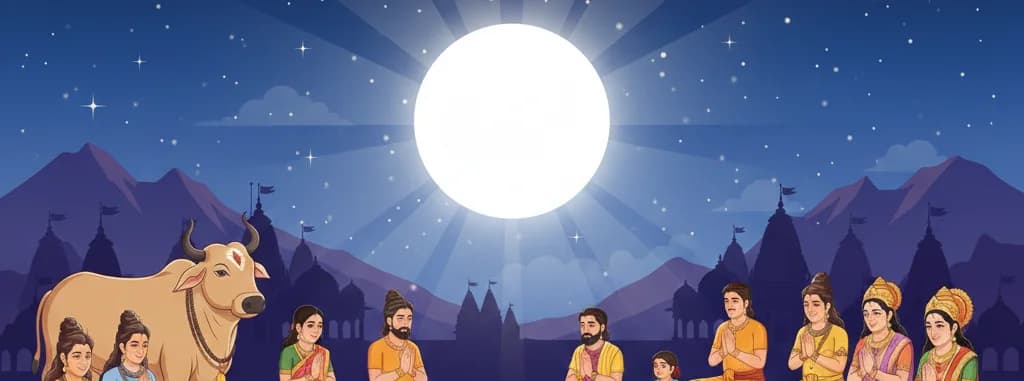
Full moon fasting day, considered highly auspicious for all spiritual practices and deity worship.
Occurrence Date
This Purnima occurs on 26 அக். because the tithi ends at 9:41 AM, which is after sunrise (6:28 AM) on this day.
According to Vedic tradition, Purnima is observed on the Gregorian day when the tithi ends after sunrise.
Vrat Timings
Moonrise · Moon darshan
5:53 PM
அக். 26, திங்.
Sight the moon and offer prayers before breaking the fast
அக். 25, ஞாயி.
- Purnima begins11:56 AM
அக். 26, திங்.
- Fast begins6:28 AM
- Purnima ends9:41 AM
- Moonrise5:53 PM
Purnima Vrat: Observing the Full Moon Day
Purnima is that day each month when the moon is completely lit up. In the Hindu tradition, people observe this day by fasting, praying, and doing spiritual activities. Usually, there are twelve Purnima days in a year, and sometimes there's a thirteenth one. Each Purnima has its own special connections, but all of them are considered good for connecting spiritually.
The appearance of the full moon has always been linked to things being whole and finished. In astrology, the moon is said to affect our minds and feelings. On Purnima, this influence is thought to be at its strongest, making it a good time for practices that help with mental clarity and emotional balance.
Why Purnima is Important
Purnima marks the end of the moon's waxing phase, meaning it's growing bigger. This completion is symbolically connected to feeling spiritually fulfilled, getting divine blessings, and expanding your awareness.
Some specific Purnimas are dedicated to particular gods or events. For instance, Buddha Purnima is about Lord Buddha, and Guru Purnima is for spiritual teachers. Kartik Purnima is linked to Lord Vishnu, and Sharad Purnima is known for offerings made under the moonlight.
Every monthly Purnima also connects with the ruling god of that lunar month, which allows for specific prayers. No matter these connections, all Purnimas are considered powerful for any kind of spiritual practice.
Purnima Fasting (Vrat)
How people observe Purnima vrat can differ. Some folks go for a complete fast from when the sun rises until the moon comes up, only drinking water. Others do a partial fast, eating things like fruits, milk, nuts, and root vegetables, but avoiding grains and beans.
The day often starts with a bath in the morning. This might happen in holy rivers or at home, using water that's been mixed with purifying things. It's traditional to wear clean, light-colored clothes.
Doing acts of kindness and giving is a big deal on Purnima. Giving food to people who need it, making donations, or helping animals is believed to increase spiritual merit. The full moon's energy is associated with having plenty, and giving is thought to help in receiving blessings.
Worship and Rituals on Purnima
Worship on Purnima can be done in many ways. Some people do the Satyanarayan Puja, which involves reading the Satyanarayan Katha and offering prasad. This ritual is believed to bring good fortune and help wishes come true.
Others worship their personal chosen god (Ishta Devata). The sincerity of the devotion is considered more important than which specific god is worshipped. Purnima's energy is seen as supporting all kinds of worship.
Worshipping the moon itself (Chandra Puja) is a common practice on Purnima. The moon god, Chandra, is said to rule over emotions and intuition. Offerings like water, milk, white flowers, and sweets are made to help balance mental and emotional states and improve intuition.
Offering water (arghya) to the moon as it rises is an important ritual. This involves pouring a mix of water, milk, and other items towards the moon, often while chanting mantras like "Om Chandraya Namaha."
Fasting Guidelines
When you're observing a Purnima fast, it's important to think about your own health. If a full fast isn't possible, a partial fast with fruits and milk is a good alternative. The main thing is to eat mindfully and stay conscious.
While fasting, it's a good idea to spend time reading spiritual texts, listening to devotional music, or just quietly thinking. This practice helps with self-discipline, encouraging you to let go of negative thoughts and feelings.
Breaking the fast usually happens after you see the moon and say your prayers. The first food you eat should be light and sattvic, like fruit or milk, followed by a simple meal.
Understanding Full Moon Energy
Old traditions understood the connection between the moon's phases and how people think and feel. The full moon's effect on ocean tides is scientifically known, and this idea is extended to its possible impact on our bodies.
The full moon is thought to energize the upper energy centers in the body, making meditation better and increasing the chance of reaching higher states of awareness. The bright moon is seen as a symbol of the mind reflecting divine wisdom.
Practices done on Purnima are believed to give faster and stronger results. Mantras, meditation, and prayers are thought to be amplified during this time.
Regional Observances
How Purnima is celebrated changes in different parts of the country. In Odisha, Kumar Purnima is observed. Rajasthan celebrates Sharad Purnima with celebrations that go on all night and offerings of kheer.
Communities near the coast might have gatherings by the sea, offering prayers to the moon. Temples often have special ceremonies and give out prasad.
Many spiritual centers organize Purnima satsangs, which include group meditation and spiritual talks, using the full moon's energy for everyone's spiritual growth.
Benefits of Purnima Observance
Regularly observing Purnima vrat is linked to having peace and balance in your mind and emotions. You might feel less anxious, and a sense of inner satisfaction can grow. Your mind might become clearer and more focused.
In terms of material things, observing Purnima is connected to having prosperity and abundance. This could show up as financial well-being, as well as richness in your relationships, work, and health.
Spiritually, observing it every month provides a regular time for renewal. It's seen as a cycle of spiritual refreshment, helping you let go of old habits and gain new understanding.
Adapting to Modern Life
While traditional observances might be tough in today's busy life, the core idea of Purnima is still reachable. Just acknowledging the day and doing some kind of mindful spiritual practice can be helpful.
Technology can help with reminders, finding online resources for prayers, and joining group practices virtually. Playing devotional music, lighting a lamp, or sticking to a vegetarian diet can also honor the day.
For families, Purnima offers chances for spiritual learning, like watching the moon rise, sharing stories, and preparing special meals together.
The Idea of Fullness
Purnima symbolizes a state of spiritual completion, where consciousness is fully lit up and filled with devotion. This state is considered a natural reality, sometimes hidden by ignorance or desires.
The fact that Purnima happens regularly serves as a reminder of this natural fullness. By aligning with its energy through fasting, worship, and meditation, people can gradually remove these obscurations and allow their inner completeness to show.
Worshipping the full moon and observing Purnima vrat is believed to bring divine grace, helping the mind become a clear reflection of the highest reality. This leads to realizing your own natural completeness.
Important Note: Purnima happens once every lunar month when the moon is fully illuminated. The exact timings change depending on where you are. It's best to check a reliable panchang for the precise Purnima tithi and moonrise times for your area. The observance is most effective when done during the actual Purnima tithi, which might not always match the astronomical full moon because of complicated lunar calculations.