
Ardra Nakshatra
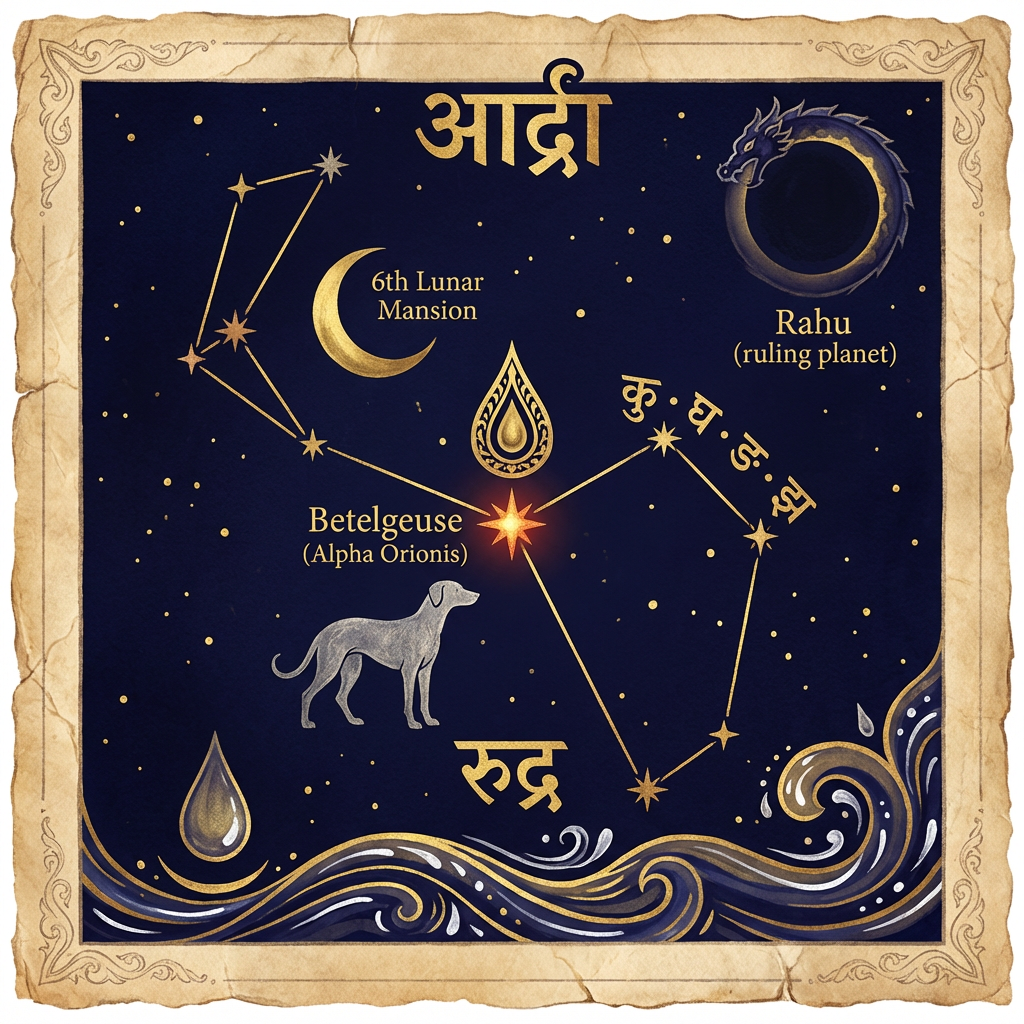
Ardra is the 6th nakshatra out of 27 in Vedic astrology. It spans 6°40' to 20°00' of Gemini. The name means "moist" or "the wet one" in Sanskrit, referring to the moisture that follows a storm. It is ruled by Rahu and governed by the deity Rudra, the Vedic storm god.
People born with their Moon, Sun, or Ascendant in Ardra tend to be intense, intellectually driven, and oriented toward change — often learning through disruption rather than smooth continuity.
Quick Facts
| Attribute | Detail |
|---|---|
| Zodiac Position | 6°40' to 20°00' Gemini |
| Nakshatra Number | 6th of 27 |
| Ruling Deity | Rudra (storm form of Shiva) |
| Ruling Planet | Rahu (North Node) |
| Symbol | Teardrop, lightning bolt, arrow |
| Animal Symbol | Female dog |
| Gender | Female |
| Guna | Tamasic |
| Gana | Manushya (human) |
| Dosha | Vata |
| Element | Water |
| Caste | Butcher |
| Body Part | Nose, eyes |
| Direction | South |
| Key Star | Betelgeuse (Alpha Orionis) |
Mythological Background
Rudra is one of the oldest deities in the Rigveda. He predates the more commonly known forms of Shiva and appears in the oldest layers of Vedic literature as a fierce, independent deity associated with storms, wind, lightning, and the untamed forces of nature. He is not bound by the same social structures as the other Vedic gods — he lives outside settled places, in the forests and mountains.
The word Rudra comes from the root "rud," meaning to cry, howl, or roar. This connects directly to Ardra's primary symbol, the teardrop. One of the important narratives around Rudra involves his origin: when the universe was being created, a being emerged from Brahma's forehead, crying intensely. When Brahma asked why it wept, the being said it had no name. Brahma named it Rudra — the howler. This story places grief and intensity at the very start of Rudra's existence, which is why Ardra carries themes of emotional depth, loss, and the growth that comes through it.
Rudra is also called Shankara (the benevolent), Mahadeva, and Pashupati (lord of animals), particularly in his capacity as a healer. The Rigveda describes him as the possessor of healing herbs and remedies, which connects to why Ardra is associated with both disruption and the restoration that follows. The storm breaks, the rain falls, and the land is eventually more fertile than before.
The key star of Ardra is Betelgeuse (Alpha Orionis), one of the largest and brightest stars visible in the night sky. It is a red supergiant in Orion's constellation, expected to eventually collapse in a supernova. The scale and eventual fate of Betelgeuse fits Ardra's theme: something vast and blazing that operates at its own pace, following its own internal cycle rather than external expectations.
In Gemini, Rudra's raw storm energy is filtered through Mercury's domain — communication, analysis, and intelligence. This produces a particular combination: people who are emotionally intense but also intellectually sharp. The storm in them is not just emotional; it moves through the mind. They analyze, investigate, and question in the same way that Rudra challenges the established order.
Rahu as the ruling planet adds another layer. Rahu is associated with ambition, unconventional paths, foreign or unusual experiences, and an appetite for what lies beyond the ordinary. Rahu does not respect convention for its own sake. Combined with Rudra and Gemini, this produces people who are genuinely curious, willing to challenge what others take for granted, and often ahead of their time in how they see things.
The three symbols of Ardra — teardrop, lightning bolt, and arrow — represent three aspects of the same energy. The teardrop is the emotional experience. The lightning bolt is the sudden insight or disruption. The arrow is the directed force that follows — taking that raw energy and pointing it at something specific.
The Four Padas
Ardra's 13°20' span divides into four padas, each in a different navamsa sign. The navamsa tells you how the nakshatra's energy channels for planets placed in that specific degree range.
Pada 1 — Ku (6°40' to 10°00' Gemini) — Sagittarius Navamsa
Jupiter rules this navamsa. The Rahu-Jupiter combination creates tension between unconventional Rahu and principle-based Jupiter, but it also produces strong intellectual drive and interest in philosophy, higher education, and foreign connections. People with planets here often channel Ardra's intensity into learning, teaching, or exploring belief systems. The restlessness has a philosophical direction.
Pada 2 — Gha (10°00' to 13°20' Gemini) — Capricorn Navamsa
Saturn rules this navamsa. Rahu and Saturn together produce someone who is ambitious and disciplined — but the discipline often comes after significant trial and error. This pada is more career-oriented and practical than the others. The disruptive energy of Ardra gets channeled into structured, long-term professional effort. These natives tend to build something real over time, even if the early path is chaotic.
Pada 3 — Ing (13°20' to 16°40' Gemini) — Aquarius Navamsa
Also Saturn-ruled, but Aquarius shifts the focus toward collective and social causes. These natives are drawn to group dynamics, reform, and work that has a broader social impact. There is often a strong sense of social responsibility paired with Ardra's natural tendency to challenge what is not working. They can be effective in advocacy, scientific research, or community-level change.
Pada 4 — Jha (16°40' to 20°00' Gemini) — Pisces Navamsa
Jupiter rules this navamsa. Of the four padas, this one is the most emotionally sensitive and spiritually inclined. The Rahu energy softens somewhat through Pisces — these natives can have strong intuitive or creative gifts. The shadow is that Pisces can diffuse Rahu's focus, leading to scattered energy if not grounded. At their best, these people combine Ardra's sharpness with genuine compassion.
Personality Traits
Strengths
- Intellectually sharp and genuinely curious — they go deep into whatever holds their attention
- Willing to challenge assumptions, including their own
- Resilient under pressure — difficulty tends to make them more focused, not less
- Perceptive about others' underlying motivations
- Can think and communicate clearly in complex, ambiguous situations
- Capable of significant empathy, particularly toward people who are suffering
- Innovative — tend to find approaches that others have not considered
- Direct in communication — say what they mean
Challenges
- Emotional volatility — intensity that works well in a crisis can become difficult to live with day to day
- Impatient with slow processes or people who they feel are not keeping up
- Tendency to be critical — the same eye that spots problems can make others feel constantly evaluated
- Rahu's influence can lead to excess — taking things further than they need to go
- Difficulty moderating emotional responses; can go from calm to intense rapidly
- The drive to transform things can mean they are not always comfortable with things staying the same, even when stability is what is actually needed
Physical Traits
Ardra natives often have sharp, alert eyes — the kind that seem to be taking in more information than they let on. The face tends toward angular features, with the nose being a notable feature (connected to the body part association). The build is often lean, and there is something restless about how they carry themselves, as though they are ready to move at any moment. They do not tend toward stillness easily. The overall impression is of someone alert and engaged rather than relaxed.
Moon in Ardra Nakshatra
When the natal Moon is in Ardra, it shapes the emotional nature and how the person instinctively responds to their inner world and to others.
Moon in Ardra creates an emotional life that operates in waves. These people feel things deeply but not smoothly — their inner state can shift relatively quickly, and they do not always have a reliable way to moderate it in real time. They tend to process emotions through the mind first — analyzing what they are feeling rather than sitting with it. This can be useful for understanding their experiences but sometimes gets in the way of actually feeling them.
The teardrop symbol is relevant here: there is often a quality of grief or intense longing associated with Ardra Moon, not necessarily sadness as a constant state, but an emotional depth that includes familiarity with loss and the kind of growth that comes only through it. These people tend to understand suffering more directly than many.
Moon in Gemini (where all of Ardra sits) is comfortable with intellectual activity — Gemini is Mercury's own sign. The Moon here tends toward curiosity and verbal processing of feelings. Moon in Ardra people often talk their way through emotional experiences, or write, or find some mental channel for what they are going through.
In practice: Moon in Ardra people are perceptive, protective of people they care about, and loyal in ways that run deeper than their outward intensity might suggest. They are not always easy to be around when they are going through something difficult, but they rarely abandon the people they have committed to.
Ardra Lagna (Ascendant)
When Ardra is the rising nakshatra, it shapes the physical appearance and the way others initially experience the person.
Ardra lagna people often have a noticeable quality of alertness or intensity in their presence. They are rarely passive observers in a room — others tend to register them. This is partly Rahu's influence, which often gives an unusual or striking quality to the appearance and manner.
These natives may come across as probing or evaluative in initial meetings — they tend to ask questions and assess rather than simply accept. This can be read as curiosity or as intensity depending on the other person. They are not always immediately warm, but once they decide someone is worth their time, they invest genuinely.
The early part of life for Ardra lagna often involves significant disruption — family changes, relocations, or periods of instability. Rahu's influence at the ascendant means the path is rarely conventional, and the most productive approach is to accept that rather than try to make the life fit a standard template. These natives tend to find their best footing once they stop comparing their trajectory to others.
Career and Professional Life
Ardra's combination of sharp intellect, tolerance for complexity, and Rahu's appetite for the unconventional makes certain fields a consistent fit.
Careers that tend to work well:
- Technology, software development, and engineering
- Research — scientific, academic, or investigative
- Law, particularly criminal law or investigation-heavy work
- Medicine — especially surgery, neurology, or psychiatry
- Journalism and investigative reporting
- Strategy, consulting, and complex problem-solving
- Writing and communication — particularly where depth of analysis is valued
- Psychology and therapy
- Fields dealing with hidden or complex systems — finance, cryptography, data analysis
The common thread is work that involves going beneath the surface of things, finding what is not obvious, and communicating it clearly. Ardra natives do not tend to do well in roles where the work is purely repetitive or where they are expected to accept things at face value without questioning.
Relationships and Compatibility
Ardra natives tend to seek relationships with intellectual substance. They need someone who can keep up with their thinking and who is not put off by emotional intensity. They are loyal and protective once genuinely committed, but the process of getting there is not always straightforward — they can be guarded initially and tend to test people through conversation and observation before fully trusting.
Nakshatra compatibility considers gana (nature), yoni (animal symbol), planetary ruler relationships, and moon sign. The table below gives a general orientation. Full Guna Milan analysis requires exact birth details for both individuals.
| Nakshatra | Compatibility | Notes |
|---|---|---|
| Ashwini | Average | Both fast-moving but different drivers; workable with mutual respect |
| Bharani | Good | Manushya gana match; Venus-Rahu connection works |
| Krittika | Challenging | Sun vs. Rahu creates fundamental tension |
| Rohini | Average | Manushya gana matches but Rohini's need for stability conflicts with Ardra's restlessness |
| Mrigashira | Average | Both curious and searching but different emotional styles |
| Ardra | Good | Same nakshatra; mutual understanding of the intensity |
| Punarvasu | Average | Jupiter-Rahu tension; Punarvasu's optimism can balance Ardra but philosophically they differ |
| Pushya | Challenging | Pushya's traditional, structured approach conflicts with Ardra's disruptive energy |
| Ashlesha | Good | Mercury-Rahu connection; both perceptive and investigative |
| Magha | Challenging | Ketu vs. Rahu creates direct opposition; very different worldviews |
| Purva Phalguni | Good | Manushya gana; Venus-Rahu works; both enjoy life with intensity |
| Uttara Phalguni | Average | Manushya gana matches but Sun-Rahu creates friction |
| Hasta | Average | Deva gana difference; Moon-Rahu creates some tension |
| Chitra | Average | Both sharp and driven but different temperaments |
| Swati | Best | Both Rahu-ruled; share independence, innovation, and unconventional thinking |
| Vishakha | Average | Jupiter-Rahu tension; Vishakha's goal-focus can clash with Ardra's process-focus |
| Anuradha | Challenging | Anuradha needs stability; Ardra creates disruption — opposing needs |
| Jyeshtha | Good | Mercury-Rahu connection; both investigate deeply and value intellectual authority |
| Mula | Good | Yoni match (male dog + female dog); both deal in transformation and root-level change |
| Purva Ashadha | Good | Manushya gana; Venus-Rahu works; both have strong drive |
| Uttara Ashadha | Average | Manushya gana but Sun-Rahu friction; different approaches to ambition |
| Shravana | Average | Deva gana; Moon-Rahu tension; Shravana's patience vs. Ardra's urgency |
| Dhanishta | Average | Rakshasa gana; Mars-Rahu has some friction but both are driven |
| Shatabhisha | Good | Both Rahu-ruled; share unconventional thinking and investigative nature |
| Purva Bhadrapada | Average | Manushya gana but Jupiter-Rahu tension |
| Uttara Bhadrapada | Average | Manushya gana; Saturn-Rahu is friendly but temperaments differ significantly |
| Revati | Average | Deva gana; Mercury-Rahu works but Revati's gentleness vs. Ardra's intensity |
Family and Friendships
Ardra natives can be fiercely loyal to the people they are genuinely close to, but the circle of people they fully trust tends to be small. They are not good at maintaining superficial relationships and may drop them entirely if they do not find real substance. In families, they sometimes become the person who names uncomfortable truths — which others may find useful or difficult depending on context.
Ardra and Its Neighboring Nakshatras
Mrigashira — 5th Nakshatra (before Ardra)
Mrigashira spans Taurus and early Gemini and is ruled by Mars. It is associated with searching, curiosity, and gentle movement from one thing to the next. Where Mrigashira tends to explore lightly and move on, Ardra goes deep and transforms what it finds. Mrigashira is the deer in search of water; Ardra is the storm that arrives once the search is complete. Both sit in Gemini's domain but express Gemini's curiosity differently — Mrigashira as a soft search, Ardra as an intense investigation.
Punarvasu — 7th Nakshatra (after Ardra)
Punarvasu spans late Gemini and early Cancer and is ruled by Jupiter. Its name means "the return of light" or "becoming good again," and it is associated with renewal after difficulty. Punarvasu naturally follows Ardra in the zodiac — the storm (Ardra) passes and things regenerate (Punarvasu). Where Ardra is the disruption, Punarvasu is the recovery and restoration. People with strong Punarvasu influence tend to be more optimistic and restoration-oriented than Ardra natives.
Famous Personalities
Several public figures are associated with Ardra Nakshatra based on commonly referenced birth charts. Placement depends on exact birth time, so these should be treated as indicative.
- Osho (Bhagwan Rajneesh) — frequently cited with Moon in Ardra; his approach to dismantling conventional belief systems and provoking new ways of thinking aligns with the nakshatra's energy
- Nikola Tesla — associated with strong Rahu influence in multiple astrological analyses; his unconventional approach to science and his position outside mainstream recognition fits the Ardra profile
- Rabindranath Tagore — cited with Ardra Moon in several Vedic astrology references; the combination of intense emotional depth and prolific intellectual output across poetry, music, and philosophy reflects both Rudra's emotional charge and Gemini's communicative quality
Note: Nakshatra placement depends on exact birth time. The associations above are based on commonly cited astrological charts and may vary by source.
Moon Transit Through Ardra
The Moon moves through Ardra for approximately 13 to 14 hours during its monthly cycle. When the Moon transits Ardra, the period carries an undertone of sharpness and intensity — good for focused work and investigation, but not ideal for activities that require calm, consensus-building, or gentle handling.
Activities that tend to go well during Ardra Moon transit:
- Deep research, investigation, or analysis
- Writing that requires precision and directness
- Surgery or medical procedures (Rudra's connection to healing herbs and transformation)
- Resolving problems that have been avoided or left unfinished
- Technology work, particularly debugging or problem-solving
- Honest, direct conversations that need to happen but have been postponed
Better to avoid:
- Signing new partnerships or agreements requiring trust-building (better on Anuradha or Pushya Moon days)
- Starting new ventures that need smooth, steady growth — Ardra's energy tends to shake things up
- Activities that require sustained patience and calm
To check when the Moon is next transiting Ardra, see the live Moon transit calendar.
Health and Wellness
Rahu's influence and Vata dosha shape Ardra's health tendencies. The body parts associated with this nakshatra are the nose and eyes. Nervous system-related issues are the most common concern — anxiety, insomnia, and stress-related symptoms that come from the mind running at high intensity for too long.
Ardra natives often have strong mental energy that they sustain for long periods without rest. This works until it doesn't — crashes and burnout are a real pattern. The restlessness that serves them professionally can become a liability when the body needs to recover.
Practical recommendations:
- Physical activity that is genuinely tiring helps discharge the nervous system — not just going through the motions but working hard enough to produce real fatigue
- Consistent sleep schedule matters more than most other interventions — irregular sleep significantly worsens Rahu-related anxiety patterns
- Grounding practices: warm foods, warm oil, time in nature — counteract Vata and Rahu's tendency to keep the system in a state of high alert
- Meditation that focuses on breath (particularly nasal breath, given the nose association) is useful — pranayama is specifically beneficial
- Avoid excessive stimulants — caffeine and similar substances can tip Ardra's already-active nervous system into anxiety
Naming Conventions
In Vedic tradition, naming a child based on their birth nakshatra is common. The first syllable of the name corresponds to the pada the Moon occupied at birth.
Name Syllables (Aksharas)
| Pada | Syllable | Degree Range |
|---|---|---|
| Pada 1 | Ku | 6°40' – 10°00' Gemini |
| Pada 2 | Gha | 10°00' – 13°20' Gemini |
| Pada 3 | Ing | 13°20' – 16°40' Gemini |
| Pada 4 | Jha | 16°40' – 20°00' Gemini |
Baby Names
Boys: Kunal, Kumar, Kushal, Kush, Kundan, Ghanshyam, Ghanendra, Jhalak, Jhanak
Girls: Kumari, Kusuma, Kuhu, Kumud, Ghanashyama, Ghanapriya, Ingita, Jhanvi, Jharna
Naming Ceremony
The Namakarana ceremony is traditionally held on the 10th or 11th day after birth. Consulting a Jyotishi to confirm the Moon's exact pada at birth is recommended before finalizing the name syllable.
Spiritual Significance and Remedies
Spiritual Lessons
Ardra's central spiritual teaching is about accepting destruction as part of a complete cycle. Rudra does not destroy arbitrarily — he removes what has become rigid, stagnant, or obstructing. The nakshatra asks its natives to develop the same quality: to be willing to dismantle what is no longer working in their own lives, without clinging to it out of habit or fear.
The teardrop symbol points to another lesson: grief and intense emotion are not problems to be fixed. They are information. Ardra natives who try to suppress or analyze away their emotional life miss what those experiences are actually trying to communicate.
Rahu's influence means there is always a pull toward more — more experience, more knowledge, more intensity. The spiritual work is in finding the internal limit: knowing when enough is enough, and developing the capacity to stop voluntarily rather than only stopping when forced to.
Mantras
- Nakshatra Mantra: Om Namah Shivaya (primary mantra for Rudra/Shiva)
- Deity Mantra: Om Namo Bhagavate Rudraya
- Rahu Mantra: Om Raam Rahave Namaha
These are traditionally chanted 108 times, preferably on Wednesdays (Mercury's day, Gemini's ruler) or Saturdays (Rahu's associated day in some traditions).
Gemstone Recommendations
- Primary: Hessonite Garnet (Gomed) — associated with Rahu; supports Rahu's positive qualities and can help reduce anxiety and scattered thinking
- Alternative: Cat's Eye (Lehsunia) for Ketu balance; Emerald (Panna) for strengthening Mercury's moderating influence in Gemini
Hessonite works differently for different chart placements. Consult a Jyotishi before wearing Rahu's stone — it amplifies whatever Rahu is doing in the chart, which is not always straightforwardly positive.
Remedial Practices
- Worship: Shiva and Rudra; the Rudrashtadhyayi (8 chapters of Rudra hymns) or simpler Shiva puja; particularly relevant on Ardra Darshanam (the day the Moon transits Ardra in the Dhanur month — a significant observance in South India)
- Charity: Supporting people affected by sudden disasters, illness, or disruption aligns with Rudra's healing aspect
- Fasting: Mondays (Shiva's day) or the day of Ardra nakshatra Moon each month
- Lifestyle: Time in nature, particularly near water or during rainfall; the rain connects directly to Ardra's meaning and can be genuinely grounding rather than just symbolic
Lucky Elements
| Element | Details |
|---|---|
| Colors | White, Silver, Grey, Dark Blue |
| Numbers | 4, 8 (Rahu and Saturn numbers) |
| Days | Wednesday (primary), Monday, Saturday |
| Gemstone | Hessonite Garnet |
| Direction | South |
| Metal | Lead, Iron |
Frequently Asked Questions
What is Ardra Nakshatra?
Ardra is the 6th of 27 lunar mansions in Vedic astrology. It spans 6°40' to 20°00' of Gemini, is ruled by Rahu, and governed by the deity Rudra. It is associated with storms, transformation, intense intellectual energy, and the kind of change that comes through disruption rather than gradual progress.
Which planet rules Ardra Nakshatra?
Rahu (the North Node of the Moon). Rahu is associated with ambition, unconventional paths, foreign or unusual experiences, and boundary-pushing. Combined with Rudra and Gemini, this produces strong intellectual curiosity and a drive to challenge what others take for granted.
What is the symbol of Ardra Nakshatra?
Three symbols: the teardrop (emotional depth and the grief that precedes growth), the lightning bolt (sudden disruption or insight), and the arrow (directed force). Together they describe how Ardra's energy moves — from deep feeling to sharp insight to focused action.
Who is the deity of Ardra Nakshatra?
Rudra — one of the oldest forms of Shiva in Vedic literature. He is the lord of storms, associated with the raw, untamed forces of nature. He is also Pashupati (lord of animals) and connected to healing herbs. Rudra breaks down what is not working; what follows is growth.
What is Ardra Nakshatra good for?
Research, investigation, surgery, writing that requires precision, debugging and problem-solving, and direct conversations that need to happen. The Moon transiting Ardra supports any activity that benefits from sharp focus and willingness to cut through what is not working.
Which nakshatra is most compatible with Ardra?
Swati is the strongest match — both are Rahu-ruled and share a drive for independence and unconventional thinking. Shatabhisha is also good for the same reason. Mula is another good match based on yoni compatibility (male dog + female dog).
What are the best careers for Ardra Nakshatra?
Technology, research, law, medicine (particularly surgery or psychiatry), investigative journalism, strategy consulting, and any field involving deep analysis and willingness to question surface-level explanations.
What does Moon in Ardra Nakshatra mean?
Moon in Ardra creates an emotional life that is deep but not smooth. These people feel intensely and tend to process emotions through their intellect. They can be protective and loyal once committed. Emotional volatility is a real challenge — the intensity that makes them perceptive can also make sustained calm difficult.
What is Ardra Nakshatra pada 2?
Pada 2 (Gha, 10°00' to 13°20' Gemini) falls in the Capricorn navamsa, ruled by Saturn. Rahu and Saturn together in this pada produce someone ambitious and capable of sustained discipline. It is the most career-focused of Ardra's four padas and tends to produce practical achievers who build something real through consistent effort.
When does the Moon transit Ardra Nakshatra?
The Moon transits Ardra for approximately 13 to 14 hours each month. Check exact dates and times on the Moon transit calendar.
What is Ardra Darshanam?
Ardra Darshanam is a significant observance in Tamil Nadu and other parts of South India. It falls on the day when the Moon transits Ardra nakshatra in the Tamil month of Margazhi (December–January). It is considered one of the most auspicious occasions for Shiva worship, particularly at Chidambaram temple, where the cosmic form of Shiva (Nataraja) is ceremonially viewed.
Conclusion
Ardra Nakshatra does not produce a gentle path. The nakshatra's energy — Rudra's storms, Rahu's appetite, Betelgeuse's scale — tends toward intensity, disruption, and the kind of change that cannot be quietly managed. People born under its influence often experience more than the average number of significant shifts in their lives.
What the nakshatra offers in return is a real capacity for going deep — in thinking, in research, in relationships, in self-examination. The same intensity that creates difficulty also creates the ability to engage with things that others avoid. Ardra natives who learn to direct that energy consistently — and who develop enough emotional regulation to stay functional when things become turbulent — tend to produce work and relationships of real substance.
The storm is not the problem. The question is what gets built once it passes.