
Anuradha Nakshatra
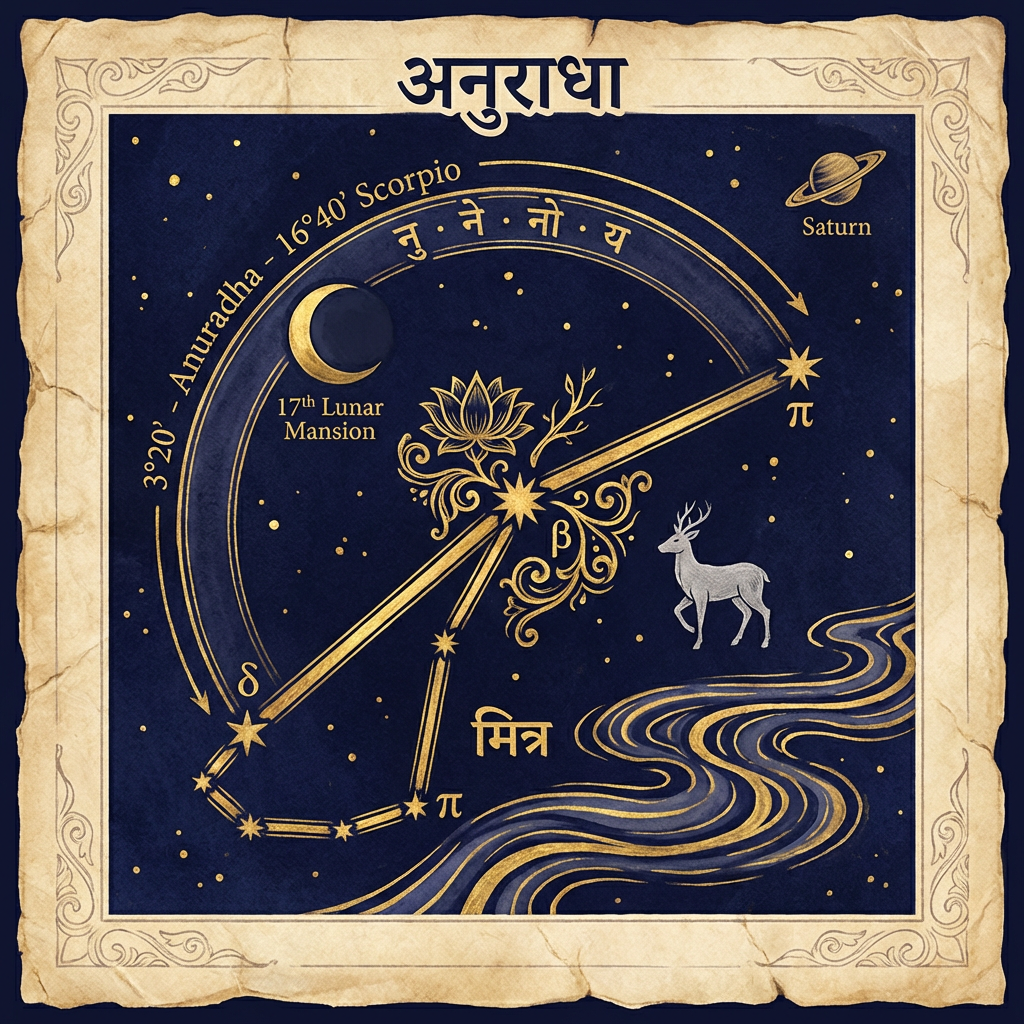
Anuradha is the 17th nakshatra out of 27 in Vedic astrology. It spans 3°20' to 16°40' of Scorpio. The name comes from Sanskrit and is generally translated as "following Radha" or "after success." It is ruled by Saturn and governed by the deity Mitra, who represents friendship and alliances.
People born with their Moon, Sun, or Ascendant in Anuradha tend to be oriented toward building connections and working toward long-term goals through collaboration rather than individual effort.
Quick Facts
| Attribute | Detail |
|---|---|
| Zodiac Position | 3°20' to 16°40' Scorpio |
| Nakshatra Number | 17th of 27 |
| Ruling Deity | Mitra (friendship, alliance) |
| Ruling Planet | Saturn |
| Symbol | Lotus flower, small twig |
| Animal Symbol | Female deer (doe) |
| Gender | Female |
| Guna | Rajasic |
| Gana | Deva |
| Dosha | Vata |
| Element | Water |
| Caste | Vaishya |
| Body Part | Heart and circulatory system |
| Direction | South |
| Key Stars | Delta, Beta, Pi Scorpii |
Mythological Background
Mitra is one of the 12 Adityas described in the Rigveda. He is the deity of contracts, mutual agreements, and alliances. Unlike many Vedic deities associated with power or destruction, Mitra's domain is entirely about cooperation. He is the force that holds promises together and maintains trust between people.
In the Rigveda, Mitra is almost always paired with Varuna. Together they are called Mitra-Varuna, one of the most frequently invoked divine pairs in Vedic literature. Mitra governs the daytime and Varuna governs the night. Mitra represents the cooperative, binding quality of the sun — warmth that draws people together rather than scorches. Varuna represents cosmic law and judgment. This pairing matters for understanding Anuradha: the alliances it favors come with a sense of responsibility and mutual obligation, not just convenience.
One hymn in the Rigveda describes Mitra as the deity who "makes people cooperate without deceit." He is said to uphold Rita, the cosmic order, through honest agreements. This explains why Anuradha natives often naturally end up in roles that require bringing groups together — diplomacy, team management, mediation, and counseling.
The name Anuradha itself means "following Radha" in some interpretations. Radha refers to the previous nakshatra Vishakha's second name (also called Radha). Anuradha, the one that comes after, carries the quality of sustained devotion and follow-through after the initial intensity of Vishakha has passed.
The lotus is one of Anuradha's two symbols. A lotus grows rooted in mud, below the water's surface, but the flower itself stays clean above the waterline. This reflects Anuradha's ability to maintain integrity while operating in difficult or complicated environments. The twig is the second symbol — something small, still growing, suggesting persistence from ordinary beginnings rather than a dramatic start.
Both symbols connect to Scorpio's water element. Scorpio is the sign of depth, research, and transformation. The combination of Scorpio's intensity with Mitra's cooperative energy produces a specific type of personality: someone who forms deep, committed bonds and works methodically toward goals through relationships rather than alone.
Saturn as the ruling planet adds a layer of discipline and delayed reward. Saturn does not make things easy — it introduces obstacles, tests patience, and rewards sustained effort over time. For Anuradha, this means early life often involves more difficulty than later years. Many Anuradha natives find that their most stable and successful periods come in their 30s and beyond, after Saturn's lessons have been absorbed.
The Four Padas
Anuradha's span of 13°20' is divided into four padas. Each pada falls in a different navamsa sign, which shifts how the nakshatra's energy expresses for planets placed there. The Moon's pada is particularly relevant for personality.
Pada 1 — Nu (3°20' to 6°40' Scorpio) — Sagittarius Navamsa
Jupiter rules this pada through the Sagittarius navamsa. The focus here shifts toward philosophy, higher learning, and long-distance or cross-cultural connections. People with their Moon in this pada often build their most important alliances through shared belief systems, spiritual communities, or educational settings. Travel and foreign connections may feature prominently.
Pada 2 — Ne (6°40' to 10°00' Scorpio) — Capricorn Navamsa
Saturn rules both the nakshatra and this navamsa, creating a vargottama effect. The Saturn energy is reinforced — this pada is the most disciplined and career-oriented of the four. These natives are practical, structured, and build alliances based on professional respect and mutual usefulness. They are often effective in business, administration, and any field requiring long-term planning. Success tends to come steadily through consistent effort.
Pada 3 — No (10°00' to 13°20' Scorpio) — Aquarius Navamsa
Also Saturn-ruled, but Aquarius shifts the orientation toward groups and collective causes rather than individual career. These natives tend to be drawn to community work, social organizations, and group-based activities. They work well within teams and are often drawn to fields that serve larger social goals. There can be a strong sense of social responsibility.
Pada 4 — Ya (13°20' to 16°40' Scorpio) — Pisces Navamsa
Jupiter rules this navamsa, bringing a more emotionally sensitive and spiritually inclined quality. This is the most intuitive of the four padas. These people form deep emotional bonds and may be drawn to healing, counseling, or creative fields. The combination of Scorpio's depth with Pisces' emotional openness makes them highly empathetic, but they can also absorb others' emotional states more than is healthy for them.
Personality Traits
Strengths
- Loyal in relationships and to people they commit to
- Disciplined and consistent when working toward goals
- Skilled at finding common ground and managing conflicts
- Empathetic and attentive to what others are going through
- Patient — able to stay with a process through long periods of difficulty
- Organized in how they structure their time and work
- Genuinely invested in the growth of people around them
- Generous with time and resources, particularly for people they trust
Challenges
- Can become possessive or controlling within close relationships
- Sets high standards for self and others, which leads to unnecessary criticism
- Holds on to past hurts longer than serves them
- Fear of failure can cause hesitation at critical decision points
- Once committed to a direction, resistant to changing course even when it would help
Physical Traits
Anuradha natives typically have a lean to medium build. The eyes tend to be expressive and direct — often the most noticeable feature when meeting someone with strong Anuradha influence. They generally carry themselves with composure in social settings. The face tends toward defined features with a calm, controlled expression. They rarely draw attention to themselves through appearance and tend to prefer functional, quality choices over anything flashy. There is often something composed and unhurried about how they move and speak.
Moon in Anuradha Nakshatra
When the natal Moon is placed in Anuradha, it shapes the emotional nature, instincts, and how the person relates to others at a core level.
Moon in Anuradha people feel most grounded when they have a few deep, trusted relationships around them. They are not casual in their connections — they invest heavily in the people they bring into their inner circle. This makes them genuinely reliable friends and partners, but it can also make the loss or breakdown of those relationships particularly difficult to handle.
These individuals tend to process emotions internally before expressing them. They do not typically show how they feel in public. Saturn's rulership of the nakshatra brings a degree of emotional restraint — they may appear entirely composed while dealing with significant personal stress. This is both a strength and a limitation: they can manage difficult situations without falling apart, but they can also suppress things that would benefit from being addressed.
The Moon in Scorpio (where all of Anuradha sits) is in its debilitation sign by classical Jyotish rules. This does not mean the person is damaged emotionally, but it does mean the emotional life is more complex and requires more conscious management. Anuradha's association with Mitra provides some balance — the orientation toward friendship and cooperation gives the Scorpio Moon a constructive outlet rather than turning inward destructively.
In practical terms: Moon in Anuradha people are dependable when things go wrong, slow to panic, and effective in managing difficult situations calmly. They are not the most open emotionally, but their care for others is consistent and real.
Anuradha Lagna (Ascendant)
When Anuradha is the rising nakshatra, it shapes the physical body, outward personality, and how others initially perceive the person.
Anuradha lagna people present as composed and controlled. They do not seek unnecessary attention but often have a quiet authority that others register. They are usually well-organized in their immediate environment and tend to maintain consistent routines.
Saturn as the nakshatra ruler means the early part of life may involve more friction and effort than peers seem to experience. Things tend to improve in the mid-30s and beyond — this is a pattern common across strong Saturn placements. These natives often look back at their earlier years as a period of necessary difficulty that built the skills they rely on later.
In professional settings, Anuradha lagna people do well in structured environments where their planning skills and reliability are recognized. Chaotic, fast-changing environments without clear frameworks tend to drain them more than most.
Career and Professional Life
Anuradha's combination of Saturn discipline, Mitra's cooperative orientation, and Scorpio's capacity for depth makes certain professional environments a consistent fit.
Careers that tend to work well:
- International relations and diplomacy
- Law, particularly mediation and contract work
- Project management and business administration
- Business development and strategic partnerships
- Psychology, therapy, and counseling
- Finance and long-term investment planning
- Healthcare coordination and management
- Social work and community development
The common thread is roles requiring sustained effort, working constructively with others, and building toward outcomes that take time to realize. Anuradha natives are generally not suited for high-variance environments where results are unpredictable and the rules keep changing.
Relationships and Compatibility
Anuradha natives seek committed, stable relationships. They are not drawn to casual or undefined connections — they prefer clarity about where things stand. Within a relationship, they are loyal, supportive, and attentive, but they need the same in return. They do not respond well to inconsistency or emotional unavailability in a partner.
Nakshatra compatibility in Jyotish considers multiple factors — gana (nature), yoni (animal symbol), planetary friendships, and moon sign relationships. The table below provides a general guide. Full Guna Milan analysis requires exact birth details for both individuals.
| Nakshatra | Compatibility | Notes |
|---|---|---|
| Ashwini | Average | Different pace; Ashwini's impulsiveness conflicts with Anuradha's need for stability |
| Bharani | Challenging | Differing values and temperament; requires significant adjustment |
| Krittika | Good | Shared sense of discipline and purpose |
| Rohini | Average | Rohini's sensuality vs. Anuradha's structured approach creates tension |
| Mrigashira | Good | Mutual curiosity and respect for the other's intelligence |
| Ardra | Challenging | Ardra's instability and unpredictability conflicts with Anuradha's need for security |
| Punarvasu | Good | Shared values around loyalty and long-term thinking |
| Pushya | Best | Both Saturn-ruled; strong alignment on loyalty, stability, and commitment |
| Ashlesha | Average | Both in water signs; some intuitive understanding but trust can be an issue |
| Magha | Challenging | Gana mismatch; different priorities in life |
| Purva Phalguni | Average | Venus vs. Saturn creates different approaches to comfort and relationships |
| Uttara Phalguni | Good | Uttara Phalguni's warmth balances Anuradha's reserve well |
| Hasta | Good | Practical compatibility; both reliable and service-oriented |
| Chitra | Average | Different energies; workable but not naturally aligned |
| Swati | Good | Both can give each other space within a committed relationship |
| Vishakha | Average | Similar ambitions but different methods; can work with communication |
| Anuradha | Good | Same nakshatra — strong mutual understanding and shared values |
| Jyeshtha | Good | Both in Scorpio; yoni match (female deer + male deer) supports compatibility |
| Mula | Average | Different life outlooks; requires deliberate compromise |
| Purva Ashadha | Challenging | Venus-ruled vs. Saturn-ruled creates lifestyle and value conflicts |
| Uttara Ashadha | Average | Both disciplined; decent compatibility with effort |
| Shravana | Good | Both value loyalty, listening, and steady effort |
| Dhanishta | Average | Mars vs. Saturn creates friction around pace and approach |
| Shatabhisha | Average | Rahu's unpredictability challenges Saturn's preference for order |
| Purva Bhadrapada | Good | Shared Jupiter influence in navamsa creates mutual understanding |
| Uttara Bhadrapada | Good | Both Saturn-ruled; strong natural compatibility |
| Revati | Average | Gentle compatibility; no major conflicts but different depths |
Family and Friendships
Anuradha natives are steady and reliable within their close circle. They are not the type to maintain a large network of casual friends — they prefer a smaller group of people they know well and trust. When someone is genuinely in their inner circle, they will show up consistently and are among the most dependable people to have in difficult times.
Anuradha and Its Neighboring Nakshatras
Vishakha — 16th Nakshatra (before Anuradha)
Vishakha spans Libra and the very start of Scorpio and is ruled by Jupiter. It is associated with ambition, goals, and the drive to achieve. Where Vishakha tends to be driven by personal achievement and can be intense and even restless in pursuing it, Anuradha is more focused on building and maintaining relationships along the way. Vishakha wants to reach the goal; Anuradha wants to reach it with people it can trust. Both nakshatras deal with partnership, but from different angles.
Jyeshtha — 18th Nakshatra (after Anuradha)
Jyeshtha sits fully within Scorpio and is ruled by Mercury. It is associated with authority, seniority, and individual power. Where Anuradha works through cooperation and shared effort, Jyeshtha prefers to lead from a position of clear authority and can be protective of that position. Both nakshatras share Scorpio's depth and intensity, but express it differently — Anuradha through alliance, Jyeshtha through authority.
Famous Personalities
Several notable people are associated with Anuradha Nakshatra based on commonly referenced birth charts. Nakshatra placement depends on exact birth time, so these associations may vary by source and should be treated as indicative.
- Indira Gandhi — Moon in Anuradha is frequently cited. Her political career involved navigating complex alliances and she operated with Saturn-like discipline through sustained periods of difficulty.
- Hillary Clinton — Often cited with Anuradha Moon. A career built through persistent effort and long-term political alliance-building.
- Bruce Lee — Associated with Anuradha in several chart analyses. The combination of disciplined training and a focus on teaching and spreading martial arts through collaboration fits the nakshatra's profile.
Moon Transit Through Anuradha
The Moon moves through each nakshatra for roughly 13 to 14 hours during its monthly cycle. When the Moon transits Anuradha, the general quality of the period favors cooperation, starting joint work, and activities that require diplomacy or trust-building.
Activities that go well during Anuradha Moon transit:
- Signing partnerships, business agreements, or contracts
- Starting collaborative projects or team meetings
- Networking and professional relationship-building
- Long-distance travel
- Devotional practices, mantra recitation, and meditation
- Mediation sessions or resolving ongoing conflicts
Better to avoid:
- Confrontational meetings where you need to assert a position strongly
- Decisions that need to be made purely on individual judgment without consultation
To check when the Moon is next transiting Anuradha, see the live Moon transit calendar.
Health and Wellness
Saturn's rulership and Vata dosha influence Anuradha's health tendencies. The body parts associated with this nakshatra are the heart and circulatory system, along with the bones — areas worth monitoring over time.
Common health patterns include stress-related issues, particularly when Anuradha natives take on more responsibility than they can sustain without support. Fatigue from overwork is frequent. They often push through exhaustion rather than rest. Joint issues, particularly in the knees and lower back, can develop with age when Saturn is additionally stressed in the chart.
Practical recommendations:
- Consistent moderate exercise works better than intense but irregular activity
- Warm foods and warm oil massages (abhyanga) help with Vata imbalances
- Rest is not optional — these natives regularly under-prioritize sleep
- Meditation or pranayama to manage internal stress that doesn't always show externally
- Regular routine is more effective for long-term health than trying different approaches
Naming Conventions
In Vedic tradition, naming a child based on their birth nakshatra is common. The first syllable of the name corresponds to the pada the Moon occupied at birth.
Name Syllables (Aksharas)
| Pada | Syllable | Degree Range |
|---|---|---|
| Pada 1 | Nu | 3°20' – 6°40' Scorpio |
| Pada 2 | Ne | 6°40' – 10°00' Scorpio |
| Pada 3 | No | 10°00' – 13°20' Scorpio |
| Pada 4 | Ya | 13°20' – 16°40' Scorpio |
Baby Names
Boys: Nutan, Naveen, Nikhil, Niranjan, Yash, Yuvraj, Yashwanth, Yashas, Nayan, Nishant, Neel, Navin, Yatharth, Yagnesh
Girls: Nupur, Nidhi, Nitya, Naina, Yamuna, Yashika, Yashaswini, Yogita, Nayantara, Niharika, Navya, Nishitha, Yamini, Yogini
Naming Ceremony
The Namakarana ceremony is typically held on the tenth or eleventh day after birth. Consulting a Jyotishi for an auspicious muhurat is recommended, particularly to choose a day when the Moon is well-placed.
Spiritual Significance and Remedies
Spiritual Lessons
Anuradha's core spiritual teaching is about the karma of relationships. Natives learn that what they build with others carries its own weight — alliances formed dishonestly or maintained through control create binding karma. The nakshatra asks for honesty in cooperation: real support, not strategic positioning dressed as friendship.
The connection to Mitra also emphasizes that fulfillment tends to come through contributing to something larger than the self. Anuradha works at its best when the native's ambition is directed toward shared goals rather than purely personal ones.
Mantras
- Nakshatra Mantra: Om Aim Hreem Shreem Anuradha Nakshatraya Namaha
- Deity Mantra: Om Mitraya Namaha
These are traditionally chanted 108 times, preferably during the waxing moon phase or on Saturdays.
Gemstone Recommendations
- Primary: Blue Sapphire (Neelam) — worn on the middle finger of the right hand to support Saturn's positive qualities
- Alternatives: Lapis Lazuli, Amethyst, Blue Topaz — less expensive options that work with Saturn's energy without the intensity of Blue Sapphire
Before wearing Blue Sapphire, consult a Jyotishi. Saturn's stone can amplify both positive and difficult placements and is not universally recommended.
Remedial Practices
- Worship: Shiva and Parvati are the primary deities; regular puja or simple daily acknowledgment
- Charity: Supporting elderly welfare, community organizations, or groups working on collective goals aligns with Mitra's energy
- Fasting: Saturdays are the traditional fasting day for Saturn
- Lifestyle: Maintaining a disciplined daily routine is itself a remedy — Saturn responds to structure
Lucky Elements
| Element | Details |
|---|---|
| Colors | Deep Blue, Indigo, White, Silver |
| Numbers | 8, 16, 25, 34 (Saturn numbers) |
| Days | Saturday (primary), Friday, Monday |
| Gemstone | Blue Sapphire |
| Direction | South, West |
| Metal | Iron, Silver |
Frequently Asked Questions
What is Anuradha Nakshatra?
Anuradha is the 17th of 27 lunar mansions in Vedic astrology. It spans 3°20' to 16°40' of Scorpio, is ruled by Saturn, and governed by the deity Mitra. It is associated with friendship, alliances, and achieving success through cooperative effort.
Which planet rules Anuradha Nakshatra?
Saturn. This makes Anuradha natives disciplined and oriented toward long-term goals, but also means early life may involve more obstacles than later years.
What is Anuradha Nakshatra good for?
Building committed relationships and partnerships, long-term projects that require sustained effort, diplomacy and mediation, and spiritual practice. The Moon transiting Anuradha is favorable for signing agreements and starting collaborative work.
Who is the deity of Anuradha Nakshatra?
Mitra, one of the Adityas from the Rigveda. Mitra is the deity of friendship, cooperation, and mutual agreements. He upholds honest alliances and is the divine principle behind trustworthy partnerships.
Which nakshatra is most compatible with Anuradha?
Pushya is the closest match — both are Saturn-ruled and share values around loyalty, security, and long-term commitment. Uttara Bhadrapada and Jyeshtha are also good matches.
What are the best careers for Anuradha Nakshatra?
Diplomacy, law, business partnerships, project management, finance, psychology, counseling, and healthcare management. Fields requiring sustained effort and working constructively with others tend to suit Anuradha natives.
What does Moon in Anuradha Nakshatra mean?
Moon in Anuradha indicates someone who processes emotions internally, invests deeply in a few trusted relationships, and is reliable in difficult situations. The emotional life can be complex due to the Moon's debilitation in Scorpio, but Mitra's cooperative energy provides a constructive outlet.
What are the lucky colors for Anuradha Nakshatra?
Deep Blue and Indigo are the primary colors. White and Silver are also favorable. These align with Saturn's energy and Scorpio's water element.
What is Anuradha Nakshatra pada 2?
Pada 2 (Ne, 6°40' to 10°00' Scorpio) falls in the Capricorn navamsa. Since Saturn rules both the nakshatra and this navamsa, it creates a vargottama effect. This pada is the most career-focused and disciplined of the four, with strong potential for professional success through consistent, structured effort.
When does the Moon transit Anuradha Nakshatra?
The Moon transits Anuradha for approximately 13 to 14 hours each month. You can check exact dates and times on the Moon transit calendar.
Conclusion
Anuradha Nakshatra sits in an interesting position — it has Scorpio's intensity but channels it through cooperation rather than control. The influence of Mitra and Saturn together creates people who form deep commitments, work steadily through difficulty, and find their most meaningful success through genuine partnerships.
The nakshatra does not promise easy progress. Saturn rarely does. But it does reward consistent effort and honest alliances over time. Anuradha natives who understand this tend to build something lasting, even if it takes longer than they expected.
For those born under Anuradha, the core question the nakshatra keeps returning to is: are the alliances you are building real, and are you bringing the same commitment to them that you expect in return?